The Frontline: A Front Office Support Analyst's Survival Guide
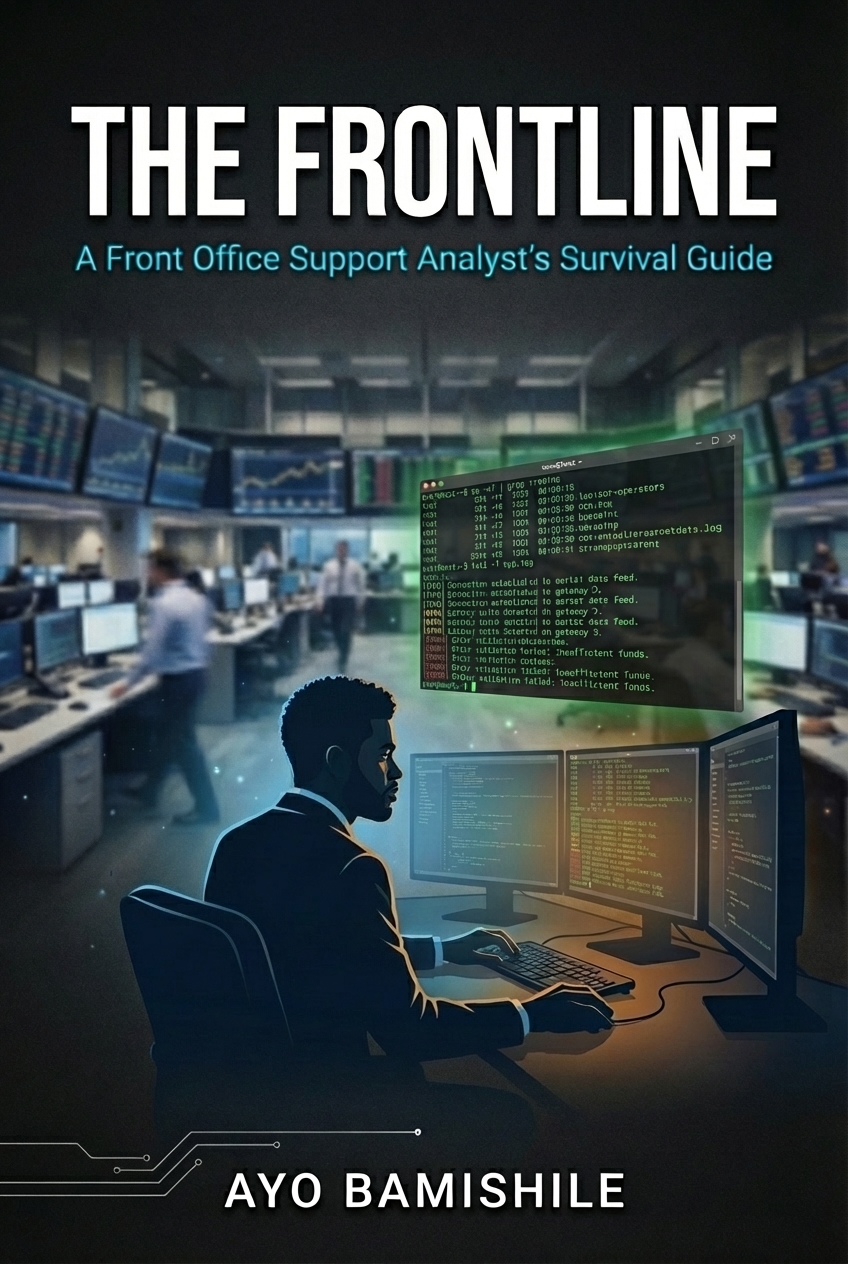
"They don't teach you how to survive a trading floor in Computer Science 101. They teach you algorithms. We need mechanics who can fix the engine while the car is doing 200mph."
About This Book
The Frontline is the definitive survival guide for aspiring and current Front Office Support Analysts in investment banking. Written by a veteran with over 15 years of experience across multiple Tier 1 banks, this book provides authentic, practical advice for navigating one of the most demanding roles in financial technology.
Theme: "Relational Battlefield" - Gritty, realistic, high-stakes, but focused on the human connections and survival.
Audience: Graduates/Career Changers (Primary: UK. Secondary: US/Aus).
Style: Guidebook (What to learn & Why), not Tutorial (How to code).
Introduction: The Frontline
- Mission Briefing: What is this book? (A survival guide, not a textbook).
- The Theatre of Operations: Define the Investment Bank (Front, Middle, Back Office).
- The Role: "Front Office Support Analyst" - The Medic/Mechanic on the frontlines.
- Global Intel: A note on regional differences (London vs NY vs Sydney).
Part 1: Recruitment (Getting Drafted)
- Chapter 1: The Draft Board (Routes to Entry)
- The Graduate Route: Unis, degrees, and the "Milk Round".
- The Mercenary Route (Recruit-Train-Deploy):
- Deep dive on the FDM/MThree/Sparta model.
- The "Bond" (Training contracts) - Warning orders.
- The Veteran Route: Career changers & Transferable skills.
- Chapter 2: The Interview Gauntlet (The Interrogation)
- The Technical Round: "Nailing the Technical Round".
- The Behavioral Grill: The STAR method (Situation, Task, Action, Result).
- The Beer Test: Culture fit - Curiosity, Resilience, Lack of Ego.
Part 2: Basic Training (The Holy Trinity)
- Chapter 3: The Engine Room (Linux/Unix)
- The "Bedrock of Enterprise Servers".
- The Command Line: Your eyes and ears (top, ps, grep, netstat).
- Guidebook Pointer: "Diagnosing System Issues: Who is eating the CPU?"
- Chapter 4: The Lifeblood (SQL & Databases)
- "Data is the lifeblood of the bank."
- Investigating Breaks: Joins, Unions, and finding the missing trade.
- Chapter 5: The Glue (Scripting & Automation)
- Python & Shell Scripting.
- "Reducing Toil": Automating checks and parsing logs.
Part 3: Deployment (The Frontlines)
- Chapter 6: The Arsenal (Day-to-Day Toolkit)
- Early Warning System: Monitoring (Geneos, AppD).
- The Logbook: Incident Management (ServiceNow, Jira).
- The Night Shift: Job Scheduling (Autosys, Control-M).
- Chapter 7: Rules of Engagement (Incident Mgmt)
- The Playbook: Acknowledge, Inform, Contain, Update (The 30-Second Rule).
- Incident vs Change Management: Putting out fires vs preventing them.
- Chapter 8: The Economic War Theatre (Domain Knowledge)
- Instruments: Equities, Fixed Income, FX, Derivatives.
- The Kill Chain (Trade Lifecycle): Order -> Execution -> Clearing -> Settlement.
- Risk: The Greeks and why they matter to IT.
Part 4: Special Forces (Career Progression)
- Chapter 9: The Promotion Ladder
- Analyst -> Associate -> VP -> MD.
- Contract vs Permanent: The Mercenary's Dilemma.
- Chapter 10: Exfiltration (Exit Strategies)
- SRE, DevOps, or the "Dark Side" (Development).
- Project Management or Sales & Trading.
Appendix: The Rucksack
- Mentor's Notes: Collected wisdom from the floor.
- Glossary: Decoding the jargon.