Appendix: The Rucksack
"The best soldiers carry the lightest packs—but they know exactly what's in them." — Unknown
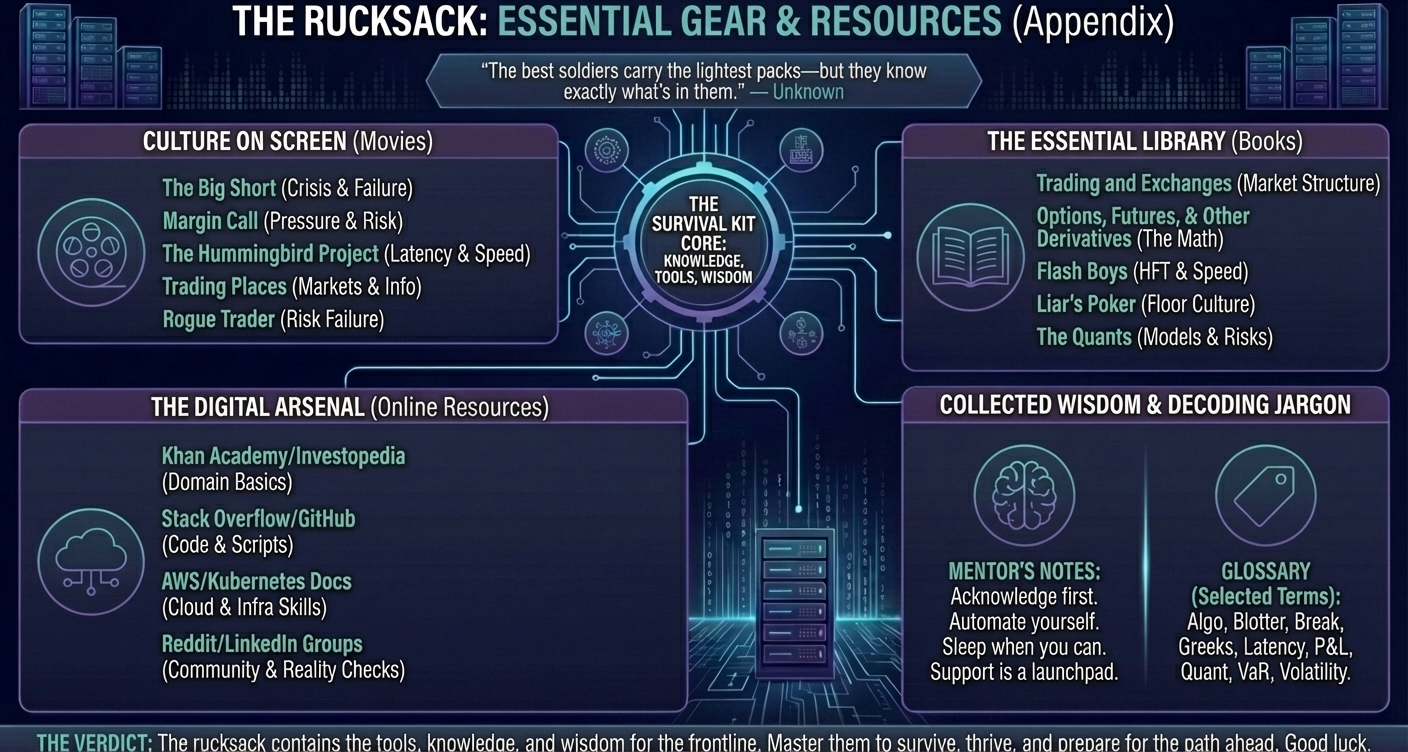
This appendix contains the resources you'll need to survive and thrive as a Front Office Support Analyst. Think of it as your rucksack—the essential gear you carry into battle.
Quick Reference Cheat Sheets
Unix Commands Cheat Sheet
Essential Commands for Daily Operations
| Command | Purpose | Example |
|---|---|---|
find | Locate files | find /apps/logs -name "*.log" -mtime -1 |
grep | Search file contents | grep -i "error" application.log |
tail | View end of file | tail -f application.log |
ps | List processes | ps -ef \| grep java |
kill | Stop process | kill -9 12345 |
df | Check disk space | df -h |
du | Directory size | du -sh /apps/trading |
netstat | Network connections | netstat -an \| grep 8080 |
top | System resources | top |
chmod | Change permissions | chmod 755 script.sh |
chown | Change ownership | chown appuser:appgroup file.txt |
tar | Archive files | tar -czf backup.tar.gz /apps/data |
ssh | Remote login | ssh user@server.bank.com |
scp | Copy files remotely | scp file.txt user@server:/tmp/ |
vi/vim | Edit files | vi config.properties |
cat | Display file | cat error.log |
less | Page through file | less large_file.log |
wc | Count lines/words | wc -l trades.csv |
sort | Sort lines | sort -n numbers.txt |
awk | Text processing | awk '{print $1}' file.txt |
Common Troubleshooting Patterns
# Find and kill hung process
ps -ef | grep trading_app
kill -9 <PID>

# Check last 100 errors in logs
grep -i "error" /apps/logs/*.log | tail -100

# Find files larger than 1GB
find /apps -type f -size +1G

# Check port availability
netstat -an | grep 8080

# Monitor log file in real-time
tail -f /apps/logs/application.log | grep -i "error"
SQL Queries Cheat Sheet
Common Troubleshooting Queries
- Find Missing Trades
- Check Trade Status
- Find Trades by Date Range
- Identify Reconciliation Breaks
- Check Batch Job Status
- Find Stale Prices
- Aggregate Trading Activity
Incident Response Checklist
The 4-Step Protocol: Acknowledge, Inform, Contain, Update
Step 1: Acknowledge (Within 30 seconds) - [ ] Answer phone/email immediately - [ ] Confirm you've received the alert - [ ] Set expectation for next update (5-15 minutes)
Template: "I see it. I'm investigating. I'll update you in 5 minutes."
Step 2: Inform (Immediately) - [ ] Notify affected desk/traders - [ ] Notify your manager - [ ] Notify dependent teams (if applicable)
Email Template:
Subject: [P1] <System Name> - <Brief Description>

Issue: <What's broken>
Impact: <Who's affected>
Status: Investigating
Next Update: <Time> (<X> minutes)
Step 3: Contain (Restore service first) - [ ] Check monitoring dashboard - [ ] Review recent changes (deployments, config) - [ ] Check logs for errors - [ ] Restart service (if safe) - [ ] Failover to backup (if available) - [ ] Rollback recent change (if cause identified)
Decision Tree: - Service down? → Restart/failover immediately - Degraded but functional? → Investigate without restarting - Known issue? → Follow runbook - Unknown? → Gather diagnostics and escalate
Step 4: Update (Every 15-30 minutes) - [ ] Send status update even if no progress - [ ] Include what you've checked - [ ] Include next steps - [ ] Set next update time
Update Template:
Post-Incident: - [ ] Document timeline - [ ] Identify root cause - [ ] Update runbook - [ ] Schedule post-mortem (if P1)
Start-of-Day Checklist
Pre-Market Checks (06:30-07:00 London time)
System Health (15 minutes) - [ ] Check monitoring dashboard (Geneos/Splunk) - All systems green? - Any alerts overnight? - [ ] Verify overnight batch jobs completed - Risk calculation - P&L reports - Settlement processing - [ ] Check disk space on critical servers - Trading servers: >20% free - Database servers: >30% free - Log servers: >40% free
Market Data Feeds (10 minutes) - [ ] Bloomberg feed active - [ ] Reuters feed active - [ ] Exchange feeds (CME, ICE, Eurex) connected - [ ] Pricing screens showing live data - [ ] Last price update < 5 minutes ago
Database Connectivity (5 minutes) - [ ] Front Office database responsive - [ ] Risk database responsive - [ ] Reference data database responsive - [ ] No blocking sessions - [ ] No long-running queries (>5 minutes)
Application Status (10 minutes) - [ ] Trading platform up - [ ] Pricing engine running - [ ] Order management system (OMS) up - [ ] Risk calculation engine running - [ ] Confirmation system active
Communication Channels (5 minutes) - [ ] Email working - [ ] Phone system operational - [ ] Instant messaging (Bloomberg/Symphony) connected - [ ] Bridge line numbers ready (for incidents)
Handover Review (5 minutes) - [ ] Read overnight shift notes - [ ] Check for any open incidents - [ ] Review any scheduled maintenance - [ ] Note any trader requests
Total Time: 50 minutes (complete by 07:20, 10 minutes before market open)
If Issues Found: - P1 (Market-impacting): Escalate immediately, follow incident protocol - P2 (Degraded): Investigate, inform stakeholders, fix before market open if possible - P3 (Minor): Document, fix during the day
Market Open (07:30) - [ ] Monitor first 15 minutes closely - [ ] Watch for any unusual activity - [ ] Be ready to respond to trader calls
Career Tools
CV/Resume Template
Front Office Support Analyst CV Structure
[YOUR NAME]
[Phone] | [Email] | [LinkedIn] | [Location]

--- PROFESSIONAL SUMMARY ---
Front Office Support Analyst with [X] years supporting mission-critical trading systems
in [asset classes]. Proven track record in incident management, system troubleshooting,
and cross-team collaboration. Strong Unix/Linux, SQL, and scripting skills.

--- TECHNICAL SKILLS ---
Operating Systems: Unix/Linux (RHEL, Solaris), Windows Server
Databases: Oracle, Sybase, SQL Server, PostgreSQL
Scripting: Python, Bash, PowerShell, Perl
Monitoring: Geneos, Splunk, Grafana, Nagios
Ticketing: ServiceNow, JIRA, Remedy
Domain: [FX/Rates/Equities/Credit], Trade Lifecycle, Market Data

--- PROFESSIONAL EXPERIENCE ---

[BANK NAME] | Front Office Support Analyst | [Dates]
• Supported [X] trading applications for [desk/asset class] generating £[X]M daily P&L
• Reduced incident response time by [X]% through automated monitoring and alerting
• Resolved [X] P1 incidents with zero SLA breaches over [X] months
• Automated [X] manual processes using Python/Bash, saving [X] hours per week
• Collaborated with traders, developers, and infrastructure teams across [X] time zones

Key Achievements:
- [Specific incident you resolved that saved money/prevented loss]
- [Automation project that improved efficiency]
- [Process improvement that reduced errors]

[PREVIOUS ROLE] | [Title] | [Dates]
• [Achievement-focused bullet points]
• [Quantify impact where possible]

--- EDUCATION ---
[Degree] in [Subject] | [University] | [Year]
[Relevant certifications: ITIL, AWS, Linux+, etc.]

--- ADDITIONAL ---
Languages: [If relevant for international banks]
Eligibility: [Right to work status]
Key Principles: - Quantify everything: "Supported 15 applications" beats "Supported trading systems" - Show impact: "Reduced incident response time by 40%" beats "Responded to incidents" - Use trader language: "Supported FX options desk generating £50M daily P&L" shows you understand the business - Keep it to 2 pages: Recruiters spend 6 seconds on first pass - Tailor for each role: Emphasize Unix for Unix-heavy roles, SQL for data-heavy roles
Cover Letter Template
Structure for Investment Banking Applications
[Your Name]
[Your Address]
[Your Email] | [Your Phone]
[Date]

[Hiring Manager Name]
[Bank Name]
[Address]

Dear [Hiring Manager Name / Hiring Team],

--- PARAGRAPH 1: THE HOOK ---
I am writing to apply for the Front Office Support Analyst position supporting
[specific desk/system]. With [X] years supporting mission-critical trading systems
at [current/previous bank], I have the technical skills and trading floor experience
to hit the ground running in this high-pressure role.

--- PARAGRAPH 2: RELEVANT EXPERIENCE ---
In my current role at [Bank], I support [X] trading applications for the [desk name],
handling [X] incidents per month with a [X]% SLA achievement rate. I have deep
experience with [Unix/SQL/scripting], and I've resolved complex issues involving
[specific technical challenge relevant to the job posting]. For example, [brief
war story showing problem-solving under pressure].

--- PARAGRAPH 3: WHY THIS ROLE ---
I am particularly interested in this role because [specific reason: new asset class,
larger scale, better technology, career progression]. I am eager to apply my
experience in [current domain] to [target domain], and I thrive in fast-paced
environments where technical excellence and business impact are equally valued.

--- PARAGRAPH 4: CLOSING ---
I would welcome the opportunity to discuss how my experience supporting [current
systems] can contribute to the [target desk/team]. I am available for interview
at your convenience and can start with [notice period].

Thank you for your consideration.

Yours sincerely,
[Your Name]
Ayo's Advice: - Keep it to one page: Hiring managers don't read long cover letters - Show you've researched the role: Mention the specific desk, system, or technology - Include a war story: One sentence showing you've solved problems under pressure - Don't repeat your CV: Add context, not duplication - Proofread ruthlessly: One typo = instant rejection in banking
LinkedIn Profile Optimization Guide
Headline (120 characters)
Bad: "IT Support Analyst" Good: "Front Office Support Analyst | Trading Systems | Unix | SQL | Python | Investment Banking"
Why: Keywords matter. Recruiters search for "Front Office," "Trading Systems," "Unix," etc.
Summary (2,000 characters)
Front Office Support Analyst with [X] years supporting mission-critical trading
systems in investment banking. I specialize in [Unix/Linux system administration],
[SQL database troubleshooting], and [incident management] for [FX/Rates/Equities]
trading desks.

TECHNICAL SKILLS
• Operating Systems: Unix/Linux (RHEL, Solaris), Windows Server
• Databases: Oracle, Sybase, SQL Server
• Scripting: Python, Bash, PowerShell
• Monitoring: Geneos, Splunk, Grafana
• Domain: [Asset classes], Trade Lifecycle, Market Data

EXPERIENCE
• Supported [X] trading applications generating £[X]M daily P&L
• Resolved [X] P1 incidents with [X]% SLA achievement
• Automated [X] processes, saving [X] hours per week
• Collaborated with traders, developers, and infrastructure teams

WHAT I DO
I keep trading systems running during market hours. When a trader calls at 07:00
because their pricing screen is blank, I'm the one who fixes it. I troubleshoot
Unix processes, query databases, analyze logs, and coordinate with developers to
resolve issues before they impact P&L.

CURRENTLY
[Current role and bank, or "Open to opportunities in Front Office Support"]

CONTACT
Open to discussing Front Office Support, DevOps, and SRE opportunities.
Key Principles: - Use emojis sparingly: They make sections scannable, but don't overdo it - Include keywords: Recruiters search for "Unix," "SQL," "Front Office," "Trading Systems" - Show personality: "I keep trading systems running" is more engaging than "Responsible for system uptime" - Update regularly: Add new skills, certifications, and achievements
Experience Section
For each role: - Use bullet points: Easier to scan than paragraphs - Quantify achievements: "Reduced incident response time by 40%" beats "Improved incident response" - Include war stories: "Resolved critical P1 incident during market hours, preventing £5M trading loss" - Add media: Screenshots of dashboards, architecture diagrams (if not confidential)
Skills Section
Add and get endorsed for: - Unix/Linux - SQL - Python - Bash Scripting - Incident Management - ITIL - Trading Systems - Front Office Support - Investment Banking - Oracle Database - Sybase - Geneos - Splunk
Tip: Ask colleagues to endorse you. Endorsements boost your profile in recruiter searches.
Recommendations
Get recommendations from: - Traders you've supported: "[Name] saved us during a critical incident..." - Managers: "[Name] consistently delivered under pressure..." - Developers you've worked with: "[Name] bridges the gap between business and technology..."
How to ask: "Hi [Name], I'm updating my LinkedIn profile. Would you be willing to write a brief recommendation based on our work together on [project/incident]? Happy to return the favor."
Activity
Post occasionally about: - Technical achievements: "Automated our daily health checks using Python, saving 2 hours per day" - Industry news: Share articles about trading technology, cloud migration, etc. - Career milestones: New certifications, promotions, project completions
Frequency: Once per month is enough. You're not an influencer; you're a technologist.
Networking Script
Scenario 1: Reaching Out to a Recruiter
Subject: Front Office Support Analyst - [X] years experience

Hi [Recruiter Name],

I came across your profile while researching Front Office Support opportunities
in London. I have [X] years supporting trading systems at [Bank], specializing
in [Unix/SQL/Python] and [asset class].

I'm currently exploring new opportunities and would welcome a conversation about
roles you're working on. I'm particularly interested in [specific area: larger
scale, new asset class, DevOps transition].

Are you available for a brief call this week?

Best regards,
[Your Name]
[Your Phone]
[Your LinkedIn]
Key Points: - Keep it short: Recruiters get 50+ messages per day - Be specific: "Front Office Support" beats "IT roles" - Show value: "[X] years at [Bank]" establishes credibility - Call to action: "Are you available for a call?" gets responses
Scenario 2: Reaching Out to Someone at Your Target Bank
Subject: Fellow Front Office Support Analyst - Quick Question

Hi [Name],

I noticed you're a Front Office Support Analyst at [Bank], supporting [desk/system].
I'm currently in a similar role at [Your Bank], and I'm researching opportunities
at [Target Bank].

Would you be open to a brief 15-minute call to share your experience? I'd love
to learn about the team, the technology stack, and the culture. Happy to share
my own experiences in return.

No pressure if you're too busy—I know how demanding the role can be!

Best regards,
[Your Name]
Key Points: - Peer-to-peer approach: "Fellow analyst" builds rapport - Specific ask: "15-minute call" is less intimidating than "pick your brain" - Offer value: "Happy to share my own experiences" makes it a two-way conversation - Acknowledge their time: "No pressure if you're too busy" shows respect
Scenario 3: Following Up After an Interview
Subject: Thank You - Front Office Support Analyst Interview

Hi [Interviewer Name],

Thank you for taking the time to meet with me today to discuss the Front Office
Support Analyst role. I enjoyed learning about [specific detail from interview:
the team's migration to cloud, the new monitoring platform, etc.].

Our conversation reinforced my interest in the role. I'm confident that my
experience supporting [current systems] and my skills in [Unix/SQL/Python] would
allow me to contribute immediately to the team.

Please let me know if you need any additional information. I look forward to
hearing about next steps.

Best regards,
[Your Name]
Key Points: - Send within 24 hours: Shows enthusiasm and professionalism - Reference specific details: Proves you were engaged in the conversation - Restate your value: Remind them why you're a good fit - Keep it brief: 3-4 sentences maximum
Scenario 4: Asking for an Internal Referral
Subject: Referral Request - Front Office Support Role

Hi [Contact Name],

I hope you're doing well. I noticed that [Bank] has an opening for a Front Office
Support Analyst supporting [desk/system] (Job ID: [X]). Given my [X] years
supporting trading systems at [Your Bank], I believe I'd be a strong fit.

Would you be comfortable referring me? I've attached my CV for your review. If
you'd like to discuss my background first, I'm happy to jump on a quick call.

I understand if you're not able to—no worries either way!

Best regards,
[Your Name]
Key Points: - Be direct: "Would you be comfortable referring me?" is clear - Make it easy: Attach your CV, include the job ID - Give them an out: "I understand if you're not able to" removes pressure - Referral bonuses: Many banks pay £1,000-£5,000 for successful referrals, so you're offering them value
Ayo's Networking Rules:
- Always follow up: If someone helps you, send a thank-you message
- Offer value first: Share an article, make an introduction, offer advice
- Keep it professional: No slang, no emojis (except LinkedIn), no typos
- Respect their time: 15-minute calls, not "coffee" (which means 1 hour)
- Stay in touch: Message once every 3-6 months, even if you don't need anything
Remember: Your network is your net worth. The person you help today might hire you tomorrow.
Resources
Movies (The Trading Floor on Screen)
If you want to understand the culture, the pressure, and the chaos of investment banking, watch these films. They're not documentaries, but they capture the spirit of the frontlines.
The Big Short (2015)
- What it's about: The 2008 financial crisis, told through the eyes of the traders who saw it coming.
- Why watch it: You'll understand mortgage-backed securities, CDOs, and credit default swaps. More importantly, you'll see how systems fail when everyone assumes they won't.
- Key takeaway: "It's not what you don't know that gets you into trouble. It's what you know for sure that just ain't so."
The Hummingbird Project (2018)
- What it's about: Two traders build a fiber-optic cable from Kansas to New Jersey to shave milliseconds off trade execution times.
- Why watch it: This is the world of high-frequency trading (HFT). You'll see the obsession with latency, the technical challenges, and the lengths people go to for a competitive edge.
- Key takeaway: In trading, milliseconds matter. Your job is to keep those systems running.
Margin Call (2011)
- What it's about: 24 hours at an investment bank during the early stages of the 2008 financial crisis.
- Why watch it: This is the most realistic portrayal of a trading floor under pressure. You'll see risk management, executive decision-making, and the human cost of financial collapse.
- Key takeaway: When the system breaks, everyone looks to IT to fix it. Fast.
The Wolf of Wall Street (2013)
- What it's about: The rise and fall of stockbroker Jordan Belfort.
- Why watch it: It's over-the-top, but it captures the excess, the ego, and the sales culture of finance. You'll meet traders like this.
- Key takeaway: Not everyone on the trading floor is ethical. Know when to walk away.
Trading Places (1983)
- What it's about: Two commodities brokers make a bet to swap the lives of a street hustler and a wealthy executive.
- Why watch it: It's a comedy, but it explains commodities trading, futures contracts, and market manipulation in a way that's actually fun.
- Key takeaway: Markets are driven by information. Control the information, control the market.
Rogue Trader (1999)
- What it's about: The true story of Nick Leeson, the trader who brought down Barings Bank in 1995.
- Why watch it: This is what happens when risk management fails. You'll see unauthorized trading, hidden losses, and the collapse of a 233-year-old bank.
- Key takeaway: Your job is to prevent this. Monitor everything. Question everything.
Reading List (The Essential Library)
Trading and Exchanges: Market Microstructure for Practitioners by Larry Harris
- Why read it: This is the bible of market structure. It explains how exchanges work, how orders are matched, and how liquidity is created. If you support trading systems, this book is essential.
- Key chapters: Order-driven markets, quote-driven markets, and market manipulation.
Options, Futures, and Other Derivatives by John C. Hull
- Why read it: The definitive textbook on derivatives. It covers options, futures, swaps, and exotic derivatives in detail. Heavy on math, but you don't need to solve every equation—just understand the concepts.
- Key chapters: Black-Scholes model, Greeks, interest rate derivatives.
The Quants: How a New Breed of Math Whizzes Conquered Wall Street and Nearly Destroyed It by Scott Patterson
- Why read it: The story of quantitative finance and the rise of algorithmic trading. You'll meet the quants, understand their models, and see how they nearly crashed the global economy in 2008.
- Key takeaway: Models are only as good as their assumptions. When assumptions break, systems fail.
Flash Boys: A Wall Street Revolt by Michael Lewis
- Why read it: The story of high-frequency trading (HFT) and how it changed the markets. You'll learn about latency arbitrage, dark pools, and the arms race for speed.
- Key takeaway: Speed matters. Your job is to keep the systems fast.
Liar's Poker by Michael Lewis
- Why read it: A memoir of life at Salomon Brothers in the 1980s. It's funny, brutal, and honest. You'll see the culture of trading floors—the egos, the pranks, the pressure.
- Key takeaway: Trading floors are intense. Develop thick skin.
The Intelligent Investor by Benjamin Graham
- Why read it: The classic book on value investing. It's not directly relevant to support work, but it'll help you understand how investors think.
- Key takeaway: Markets are driven by fear and greed. Your systems need to handle both.
Online Resources (The Digital Arsenal)
Khan Academy (Finance & Capital Markets)
- URL: https://www.khanacademy.org/economics-finance-domain/core-finance
- What it covers: Free courses on stocks, bonds, options, futures, and financial markets. Perfect for building domain knowledge.
- Best for: Beginners who need to understand the basics.
Investopedia
- URL: https://www.investopedia.com
- What it covers: Definitions, tutorials, and articles on every financial concept imaginable. Your go-to reference for domain knowledge.
- Best for: Quick lookups when you hear a term you don't understand.
Jobserve (Salary Benchmarking)
- URL: https://www.jobserve.com
- What it covers: IT contract and permanent job listings in the UK. Use it to benchmark salaries and see what skills are in demand.
- Best for: Negotiating your next contract or permanent role.
LinkedIn Groups
- Groups to join:
- "Investment Banking Technology Professionals"
- "DevOps & SRE Community"
- "Financial Services IT"
- Why join: Network with other support analysts, share war stories, and learn about job opportunities.
Stack Overflow
- URL: https://stackoverflow.com
- What it covers: Q&A for programming and scripting. If you're stuck on a Python script or a SQL query, someone has already asked (and answered) your question.
- Best for: Troubleshooting code.
GitHub
- URL: https://github.com
- What it covers: Open-source code repositories. Search for trading systems, pricing models, or automation scripts. Learn from other people's code.
- Best for: Building your own scripts and learning by example.
AWS Training and Certification
- URL: https://aws.amazon.com/training
- What it covers: Free and paid courses on AWS services. If you're pivoting to DevOps or SRE, start here.
- Best for: Learning cloud infrastructure.
Kubernetes Documentation
- URL: https://kubernetes.io/docs
- What it covers: Official Kubernetes docs. If you're supporting containerized applications, this is your bible.
- Best for: Understanding orchestration and deployment.
Reddit (r/FinancialCareers, r/devops, r/sysadmin)
- URLs:
- https://www.reddit.com/r/FinancialCareers
- https://www.reddit.com/r/devops
- https://www.reddit.com/r/sysadmin
- What it covers: Career advice, war stories, and technical discussions. Brutally honest and often hilarious.
- Best for: Reality checks and unfiltered advice.
Mentor's Notes (Collected Wisdom)
These are the lessons I learned the hard way. Save yourself the pain.
On Incidents:
- "Acknowledge first, investigate second. Silence is worse than bad news."
- "If you don't know, say you don't know. Guessing makes it worse."
- "Document everything. Your memory is not a reliable witness."
On Traders:
- "Traders are not your enemy. They're under pressure. Help them, and they'll remember."
- "Never argue with a trader during market hours. Wait until the close."
- "If a trader says it's urgent, it's urgent. If they say it's critical, drop everything."
On Career:
- "Support is a launchpad, not a destination. Learn, then move."
- "Automate yourself out of a job. Then find a better job."
- "Your network is your net worth. Stay in touch with everyone."
On Technology:
- "The best code is no code. The second-best code is someone else's code."
- "If it's not monitored, it's not in production."
- "Backups are useless. Restores are priceless."
On Survival:
- "Sleep when you can. Eat when you can. The market doesn't care if you're tired."
- "Know when to fight, when to flee, and when to laugh it off."
- "This job will test you. But it won't break you unless you let it."
Glossary (Decoding the Jargon)
Algo: Short for "algorithm." Automated trading strategies that execute orders based on predefined rules.
Basis Point (bp): One-hundredth of a percentage point (0.01%). Used to describe interest rate changes.
Blotter: A record of all trades executed by a trader or desk. Your first stop when investigating a trade break.
Book: A trader's portfolio of positions. "The book is down $2 million" means the trader has lost $2 million.
Break: A discrepancy between two systems (e.g., trade capture vs. risk system). Your job is to find and fix it.
Clearing: The process of reconciling and settling trades between buyers and sellers.
Delta: The rate of change of an option's price relative to the underlying asset's price. One of the Greeks.
Desk: A group of traders who trade the same asset class (e.g., "the FX desk," "the rates desk").
EOD: End of Day. The time when daily processes run (risk calculations, P&L reports, etc.).
Fill: The execution of an order. "Did the order fill?" means "Did the trade execute?"
Front Office: The revenue-generating part of the bank (traders, sales, structuring).
Greeks: Risk measures for options (Delta, Gamma, Vega, Theta, Rho). Named after Greek letters.
HFT: High-Frequency Trading. Algorithmic trading that executes thousands of trades per second.
ITIL: Information Technology Infrastructure Library. A framework for IT service management.
Latency: The delay between an action and its result. In trading, lower latency = faster execution = competitive advantage.
Mark-to-Market (MTM): Valuing a position based on current market prices. Used to calculate P&L.
Middle Office: Risk management, compliance, and trade support. The bridge between Front and Back Office.
NAV: Net Asset Value. The value of a fund's assets minus its liabilities.
OTC: Over-the-Counter. Trades executed directly between two parties, not on an exchange.
P&L: Profit and Loss. The daily scorecard for traders. Your systems calculate this.
Prime Brokerage: Services provided by banks to hedge funds (trade execution, clearing, financing).
Quant: A quantitative analyst who builds mathematical models for pricing, risk, or trading strategies.
Settlement: The final step in the trade lifecycle, where cash and securities are exchanged.
SLA: Service Level Agreement. The contract that defines uptime, response times, and penalties for failure.
Spread: The difference between the bid price (what buyers will pay) and the ask price (what sellers want).
Swap: A derivative contract where two parties exchange cash flows (e.g., fixed interest rate for floating interest rate).
Tick: The minimum price movement of a security. In FX, a tick is often 0.0001 (one pip).
VaR: Value at Risk. A measure of potential loss over a given time period. Used by risk managers.
Vega: The rate of change of an option's price relative to volatility. One of the Greeks.
Vol: Short for "volatility." A measure of how much an asset's price fluctuates. High vol = high risk.
Final Words
You've reached the end of the guidebook. You know the routes to entry, the skills to learn, the tools to master, and the career paths to pursue. You've read the war stories, learned the jargon, and seen the battlefield.
Now it's your turn.
Front Office Support is not for everyone. It's high-pressure, high-stakes, and sometimes thankless. But if you survive, you'll have skills that are valuable everywhere. You'll understand systems, data, and risk. You'll know how to troubleshoot under pressure and communicate across teams. You'll have domain knowledge that most developers will never learn.
The frontline is waiting. Are you ready?
"The best time to plant a tree was 20 years ago. The second-best time is now." — Chinese Proverb
Good luck. You'll need it.