Chapter 1: The Battlefield
You're about to enter a war zone.
Not the kind with bullets and mortars, but the kind where a single typo in a database can cost $50 million before breakfast. Where a server crash at 06:45 means traders in London, New York, and Tokyo are screaming into their phones simultaneously. Where "P1 incident" means you're about to have the worst day of your month—or the best story for the pub later.
Welcome to Investment Banking IT. Specifically, Front Office Support—the role nobody tells you about in university, but the one that keeps the entire financial system from collapsing every single day.
Before we talk about how to get this job, how to survive the interview, or what commands you need to memorize, you need to understand where you are. You need to see the battlefield.
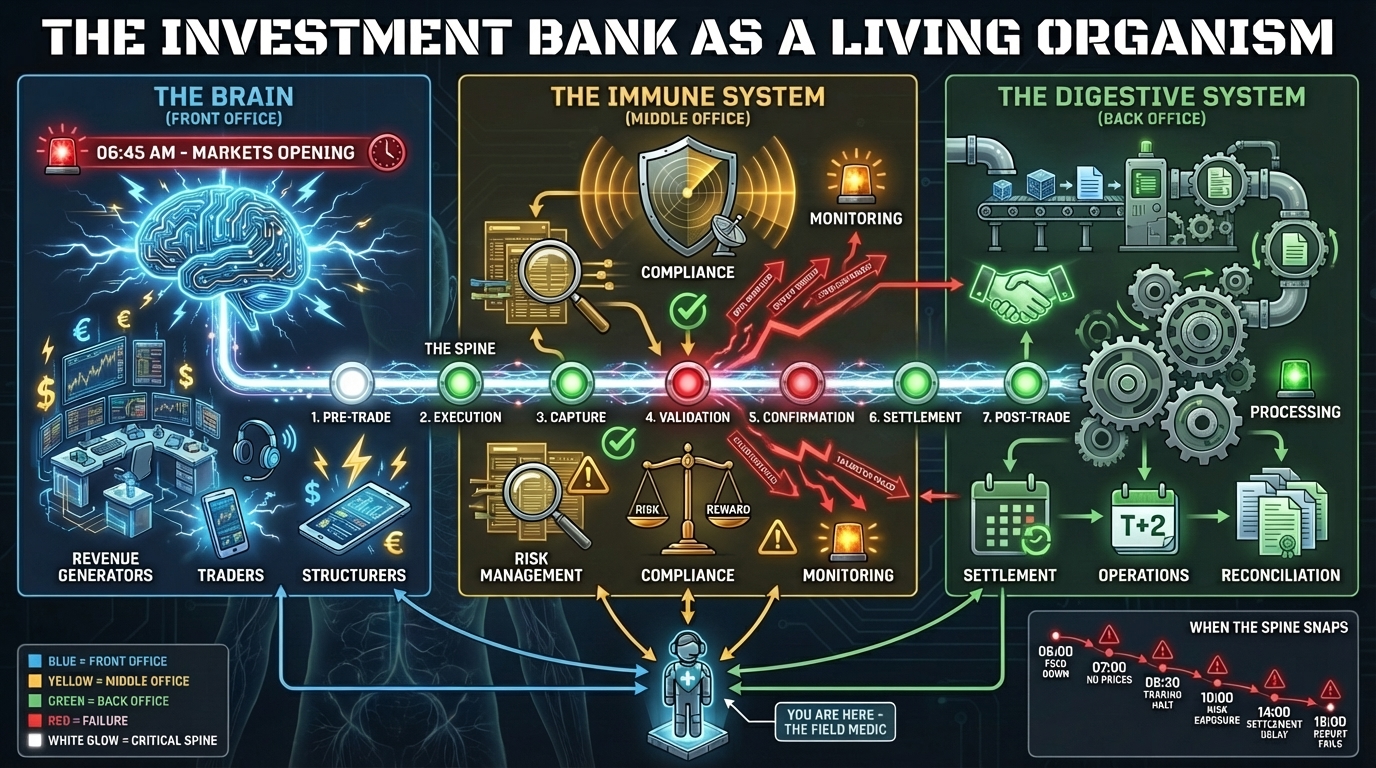
The Three Kingdoms: Front, Middle, Back Office
Investment banks are not monolithic entities. They are biological ecosystems—complex, interdependent, and ruthlessly efficient. There are three distinct regions, each with its own culture, priorities, and tolerance for failure.
Front Office: The Brain (High Risk, High Reward)
This is where the money is made. Traders, salespeople, and structurers sit here. They are the revenue generators. Everything else in the bank exists to support them.
What they do: - Execute trades (equities, bonds, derivatives, FX, commodities). - Manage client relationships (hedge funds, pension funds, corporates). - Structure complex financial products (exotic options, structured notes).
What they care about: - Speed: Milliseconds matter. A slow system = lost opportunity = lost money. - Uptime: If the trading platform is down, they can't trade. If they can't trade, the bank loses money. If the bank loses money, heads roll. - Accuracy: A mispriced derivative can cost millions. A missing trade can trigger regulatory fines.
The culture: - Aggressive, high-pressure, ego-driven. - Traders will shout at you. It's not personal. (Okay, sometimes it's personal.) - They don't care about your "root cause analysis." They care about when it will be fixed.
Your role as Support Analyst: You are the field medic for the Front Office. When their systems break, you are the first responder. You don't have time to read documentation or consult Stack Overflow. You need to know the system cold, diagnose the issue in seconds, and either fix it or escalate it to someone who can.
War Story: The 06:45 Panic (ABN Amro, 2008)
It's 06:45 on a Tuesday. London markets open in 15 minutes. I'm on my second coffee, running my start-of-day checks on the Osiris Structured Rates platform. Everything looks green in Geneos. Then my phone rings.
"Ayo, the pricing screen is blank. Nothing's loading."
It's the head of the Rates desk. His voice has that edge—controlled panic.
I SSH into the pricing server. The process is running. Logs show no errors. I check the database:
Zero rows. No market data in the last hour.
I check the upstream feed from Bloomberg. Connection refused. The network team had done "routine maintenance" overnight and forgot to restart the market data gateway.
I call the network team. They restart the gateway. Data starts flowing. Pricing screens populate. Markets open. Crisis averted.
Total time: 8 minutes.
The desk head doesn't say thank you. He just grunts and hangs up. That's Front Office gratitude.
Middle Office: The Immune System (Risk and Compliance)
If Front Office is the brain making decisions, Middle Office is the immune system—constantly scanning for threats, ensuring the organism doesn't destroy itself.
What they do: - Risk Management: Calculate Value at Risk (VaR), stress test portfolios, monitor exposure limits. - Compliance: Ensure trades comply with regulations (MiFID, Dodd-Frank, Basel III). - Valuation: Independent pricing verification (IPV)—making sure traders aren't lying about their P&L.
What they care about: - Accuracy: A wrong risk calculation can lead to catastrophic losses (see: 2008 financial crisis). - Auditability: Regulators will ask, "How did you calculate this?" You need to show your work. - Controls: Segregation of duties, maker-checker workflows, audit trails.
The culture: - Methodical, process-driven, paranoid (in a good way). - They will ask you for evidence. "Show me the logs." "Prove the data is correct." - They are the ones who say "no" when traders want to bypass controls.
Your role as Support Analyst: You ensure the risk systems are producing accurate, timely data. If the overnight risk batch job fails, traders can't see their positions. If the P&L report is wrong, the bank might be breaking regulatory capital requirements without knowing it.
War Story: The Missing Trades (RBS, 2010)
It's 07:30. The Risk team reports that 200 trades are missing from the overnight risk run. The Front Office swears they executed the trades. The Back Office confirms the trades settled. But Risk can't see them.
I start digging. The trades are in the Front Office database (Sybase). They're in the Back Office database (Oracle). But they're not in the Risk database (also Oracle, different schema).
I check the ETL (Extract, Transform, Load) job that moves data between systems. It ran. No errors. But the row count is off.
I query the source and target:
-- Source (Front Office)
SELECT COUNT(*) FROM trades WHERE trade_date = '2010-05-12';
-- Result: 1,200

-- Target (Risk)
SELECT COUNT(*) FROM trades WHERE trade_date = '2010-05-12';
-- Result: 1,000
200 trades missing. I check the ETL logs. Buried in the middle:
The trades referenced a new product type that didn't exist in the Risk system's reference data. The ETL job silently skipped them.
I manually insert the missing product type into the reference data table, re-run the ETL job, and the 200 trades appear. Risk team happy. Crisis averted.
Lesson: ETL jobs lie. They say "success" even when they skip rows. Always check the row counts.
Back Office: The Digestive System (Operations and Settlement)
If Front Office is the brain and Middle Office is the immune system, Back Office is the digestive system—processing the "food" (trades), extracting value, and eliminating waste.
What they do: - Trade Confirmation: Verify trade details with counterparties. - Settlement: Ensure cash and securities are exchanged (T+2 for equities, T+1 for FX). - Reconciliation: Match internal records with external records (custodians, clearinghouses). - Corporate Actions: Handle dividends, stock splits, bond maturations.
What they care about: - Accuracy: A settlement failure can trigger penalties and damage client relationships. - Timeliness: Trades must settle on time. Delays cost money. - Reconciliation: Every trade must match. Breaks (discrepancies) must be investigated and resolved.
The culture: - Detail-oriented, process-driven, less glamorous than Front Office. - They work longer hours than you think. Settlement cycles span multiple time zones. - They are the unsung heroes. When everything works, nobody notices. When something breaks, everyone blames them.
Your role as Support Analyst: You keep the settlement systems running. If the overnight settlement batch fails, trades don't settle. If trades don't settle, the bank faces regulatory fines and client complaints.
War Story: The Partition Disaster (Sainsbury's Bank, 2016)
I'm working on a data migration project—moving 10 years of transaction history from a legacy Oracle database to a new partitioned schema. The goal: improve query performance by partitioning data by month.
We test the migration in UAT (User Acceptance Testing). Everything works. We get sign-off. We schedule the production migration for a Saturday night.
Saturday, 22:00. I kick off the migration script. It's supposed to take 6 hours. At 02:00, I check the progress. It's at 40%. At 04:00, it's at 60%. At 06:00, it's at 80%. At 08:00, it's still at 80%.
Something's wrong.
I check the database. The script is stuck on a single partition—December 2015. That month had 10x more transactions than any other month (Christmas shopping). The partition is too large. The script is thrashing.
Markets open in 1 hour. If the migration isn't done, the settlement system can't access historical data. Trades won't settle.
I make a call: abort the migration, roll back to the old schema.
I run the rollback script. It takes 30 minutes. At 08:45, the system is back online. Settlement runs. Crisis averted.
Lesson: Always have a rollback plan. And always test with production-like data volumes.
The Spine: The Trade Lifecycle (Where Things Snap)
Now that you understand the three kingdoms, you need to understand the connective tissue—the process that binds them all together. In investment banking, this is called the Trade Lifecycle.
Think of it as the spine of the organism. When it's healthy, the bank functions. When it snaps, the organism is paralyzed.
The Trade Lifecycle: From Birth to Death
Every trade—whether it's a simple equity purchase or a complex interest rate swap—goes through the same lifecycle:
Pre-Trade (The Setup)
- Market Data: Real-time prices from exchanges (Bloomberg, Reuters, Eurex).
- Reference Data: Product definitions, counterparty details, pricing models.
- Risk Limits: Trader checks if they have enough risk capacity to execute the trade.
What can break: - Market data feed goes down → Traders can't see prices → Can't trade. - Reference data is stale → Pricing models use wrong parameters → Mispriced trades.
Your job: Ensure market data feeds are flowing. Ensure reference data is up-to-date.
Trade Execution (The Decision)
- Trader decides to buy/sell.
- Trade is entered into the Front Office system (e.g., trading platform, order management system).
- Trade is sent to the exchange or executed over-the-counter (OTC) with a counterparty.
What can break: - Trading platform crashes → Traders can't enter trades → Lost revenue. - Connectivity to exchange fails → Orders don't reach the market → Missed opportunities.
Your job: Ensure the trading platform is up. Ensure connectivity to exchanges is stable.
Trade Capture (The Record)
- Trade details are captured in the Front Office database.
- Trade is assigned a unique Trade ID.
- Trade is enriched with additional data (counterparty, settlement instructions, fees).
What can break: - Database is full → Trades can't be saved → Data loss. - Duplicate Trade IDs → Reconciliation nightmare.
Your job: Monitor database health. Ensure no duplicate trades.
Trade Validation (The Check)
- Middle Office validates the trade:
- Does it comply with risk limits?
- Does it comply with regulations?
- Is the pricing correct?
What can break: - Validation rules are wrong → Bad trades get through → Regulatory fines. - Validation system is down → Trades pile up → Bottleneck.
Your job: Ensure validation systems are running. Investigate validation failures.
Trade Confirmation (The Handshake)
- Back Office sends a confirmation to the counterparty.
- Counterparty confirms the trade details match.
- If there's a discrepancy, it's flagged as a break and must be resolved.
What can break: - Confirmation system is down → Counterparties don't receive confirmations → Settlement delays. - Trade details don't match → Break → Manual investigation required.
Your job: Ensure confirmation systems are sending messages. Investigate breaks.
Trade Settlement (The Exchange)
- Cash and securities are exchanged.
- For equities: T+2 (trade date + 2 business days).
- For FX: T+1 or T+0 (same day).
- Settlement happens through clearinghouses (e.g., LCH, DTCC).
What can break: - Settlement system is down → Trades don't settle → Penalties. - Insufficient cash/securities → Settlement fails → Client complaints.
Your job: Ensure settlement batch jobs run. Investigate settlement failures.
Post-Trade (The Aftermath)
- Reconciliation: Match internal records with external records (custodians, clearinghouses).
- Reporting: Generate regulatory reports (MiFID, Dodd-Frank).
- Archiving: Store trade data for audit purposes (7+ years).
What can break: - Reconciliation breaks → Discrepancies → Manual investigation. - Reporting system fails → Regulatory fines.
Your job: Ensure reconciliation jobs run. Ensure regulatory reports are generated on time.
When the Spine Snaps: The Cascade Effect
Here's the terrifying truth: every step in the Trade Lifecycle depends on the previous step. If one step fails, the entire chain breaks.
Example: The Domino Effect
- Market data feed goes down at 06:00.
- Traders can't see prices at 07:00.
- Trades are delayed until 08:00.
- Trade capture system is overwhelmed with a backlog at 09:00.
- Validation system times out due to high load at 10:00.
- Confirmations are delayed until 11:00.
- Settlement fails at 17:00 because confirmations weren't sent on time.
- Regulatory report is incomplete at 18:00 because settlement data is missing.
One failure at 06:00 cascades into eight failures by 18:00.
This is why Front Office Support is a high-pressure role. You're not just fixing a single system. You're preventing a cascade.
Your Role: The Field Medic
So where do you fit in this ecosystem?
You are the field medic. You don't design the systems (that's the developers). You don't make the trading decisions (that's the traders). You don't set the risk limits (that's the risk managers).
You keep the systems alive.
When something breaks, you are the first responder. You diagnose the issue, apply a temporary fix (restart a service, clear a queue, kill a hung process), and escalate to the specialists (developers, DBAs, network team) if needed.
You are the connective tissue between the business and technology. You speak both languages. You translate trader panic into technical tickets. You translate developer jargon into business impact.
You are the reason the bank doesn't collapse every day.
Part 2: The Routes In (How Do You Actually Get This Job?)
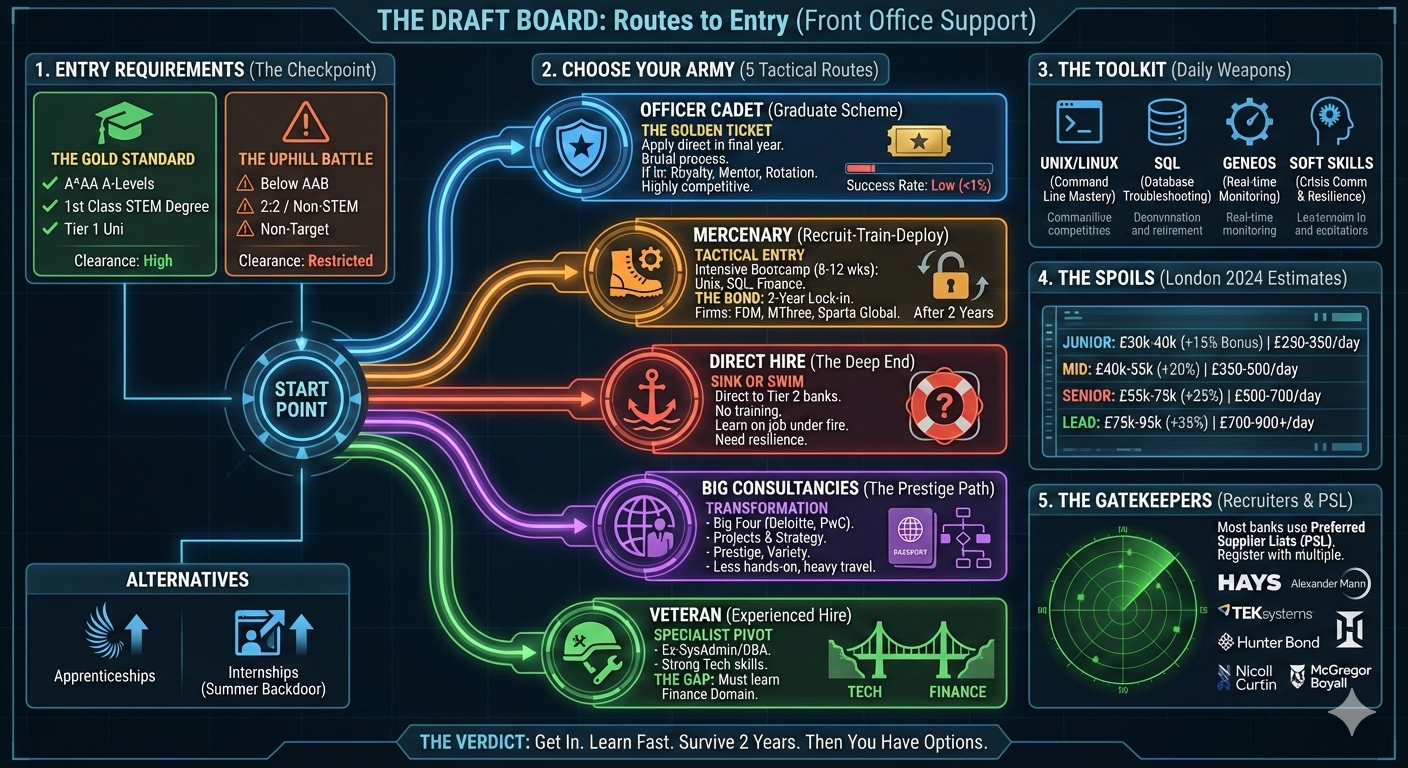
Now you understand the battlefield. But how do you get deployed to it?
There are two main routes into Front Office Support in investment banking. I call them the Officer Route and the Mercenary Route. Both work. Both have trade-offs.
Route 1: The Officer (Graduate Schemes)
What it is: Banks recruit graduates directly into structured training programs. Think: Barclays Graduate Scheme, JP Morgan Technology Analyst Program, Goldman Sachs Engineering Division.
The process: - Apply in your final year of university (September-December). - Online tests (numerical reasoning, logical reasoning, coding challenges). - Video interview (pre-recorded questions, you have 60 seconds to answer). - Assessment Centre (full day: group exercises, technical tests, interviews). - Offer (if you survive).
The benefits: - Prestige: You're a "direct hire." The bank invested in you. - Training: Structured onboarding. You'll get classroom training on the systems, the business, and the bank's culture. - Career path: Clear progression from Analyst → Associate → VP. - Stability: Permanent contract from day one. Pension, healthcare, bonuses.
The downsides: - Competition: 100+ applicants per role. You're competing with Oxbridge grads, Imperial engineers, and LSE economists. - Timing: If you miss the recruitment window (usually September-December), you wait another year. - Rigidity: You're locked into the bank's rotation program. You might get placed on a desk you don't want.
Who this works for: - Top-tier university graduates (Russell Group, Ivy League). - People with internship experience at banks. - People who are good at "the game" (assessment centres, competency questions).
Real-World Example:
A colleague at RBS came through the graduate scheme. He had a First from Cambridge, an internship at Morgan Stanley, and aced the assessment centre. He started in July, got 6 weeks of classroom training, then rotated through three desks (Equities, FX, Rates) before settling into a permanent role.
He was earning £45k base + £10k bonus by year two. By year five, he was an Associate on £70k.
The catch: He was brilliant, polished, and knew how to navigate corporate politics. If that's not you, there's another way.
Route 2: The Mercenary (Recruit-Train-Deploy Firms)
What it is: Third-party firms recruit graduates, train them for 8-12 weeks, then deploy them to banks as contractors. The big players: FDM Group, MThree (formerly Metis), Sparta Global, QA Consulting.
The process: - Apply online (rolling recruitment, no strict deadlines). - Aptitude test (logical reasoning, basic coding). - Interview (technical + behavioral). - Offer (conditional on completing training). - Training (8-12 weeks: Unix, SQL, Java, soft skills). - Deployment (placed at a bank as a contractor).
The benefits: - Lower barrier to entry: You don't need a First from Oxbridge. You need aptitude and attitude. - Training: They teach you the skills you need. You don't need prior experience. - Guaranteed placement: If you pass the training, they place you at a bank. No more job hunting. - Tier 1 experience: You'll work at the same banks as the "Officers"—RBS, Barclays, Credit Suisse, Nomura.
The downsides: - The Bond: You sign a 2-year contract. If you leave early, you owe them £15k-£25k (training costs). - Lower pay initially: You're a contractor, but you're paid less than market rate for the first 2 years (£25k-£35k). - Stigma: Some people look down on "FDM grads." Ignore them. You're doing the same job.
Who this works for: - Graduates from non-target universities. - Career changers (ex-military, ex-teachers, people pivoting from other industries). - People who missed the grad scheme window. - People who learn by doing, not by studying.
My Story: FDM, 2007
I graduated with a Computer Science degree from a mid-tier UK university. I applied to grad schemes at Barclays, RBS, and HSBC. I got rejected from all of them. My CV wasn't strong enough. My interview skills were mediocre.
Then I found FDM.
I applied in March 2007. I did the aptitude test (passed). I did the interview (passed). I got an offer in April. I started training in May.
The training was intense: 8 weeks, Monday to Friday, 9 AM to 5 PM. We learned: - Unix/Linux: Basic commands, shell scripting, file permissions. - SQL: SELECT, JOIN, WHERE, GROUP BY. - Java: Object-oriented programming, JDBC, basic web apps. - Soft skills: How to write emails, how to handle pressure, how to deal with difficult stakeholders.
In July 2007, I was deployed to ABN Amro in London. My role: Front Office Support Analyst for the Structured Rates desk.
My salary: £28,000. Market rate for a contractor at my level: £35,000-£40,000. I was underpaid, but I didn't care. I was working at a Tier 1 bank, supporting exotic derivatives, learning from senior engineers.
The 2-year bond:
Yes, I was locked in for 2 years. Yes, I could have earned more elsewhere. But here's what I got:
- Experience: I supported systems that priced Bermudan Swaptions and Asian Options. I learned Oracle, Sybase, Unix, and Python. I worked on the trading floor during the 2008 financial crisis.
- Network: I met developers, DBAs, traders, and risk managers. I built relationships that led to my next three jobs.
- Confidence: I went from "graduate with no experience" to "analyst who can troubleshoot a production outage at 3 AM."
After 2 years, I left FDM. I joined RBS as a permanent employee on £45,000. Within 5 years, I was on £70,000. Within 10 years, I had pivoted into DevOps and was earning six figures.
The FDM bond wasn't a trap. It was a launchpad.
Route 3: The Side Door (Internal Transfers)
What it is: You join the bank in a different role (Help Desk, Infrastructure, QA), then transfer internally to Front Office Support.
The benefits: - You're already inside. You know the culture, the systems, the people. - Internal transfers are easier than external applications.
The downsides: - You might spend 1-2 years in a role you don't want before you can transfer. - Not all banks allow internal transfers easily.
Who this works for: - People who are already working in IT but want to move into banking. - People who are willing to "pay their dues" in a less glamorous role first.
Route 4: The Specialist (Niche Skills)
What it is: You have a specialized skill (e.g., Murex developer, Calypso support, Bloomberg API expert) and banks hire you directly.
The benefits: - High demand. Banks will pay a premium for niche skills. - You can negotiate better terms (salary, contract length, remote work).
The downsides: - You need the niche skill first. This usually means 2-3 years of experience elsewhere.
Who this works for: - People who have already worked in financial services and want to specialize. - People who are willing to invest time learning a niche platform.
Which Route Should You Take?
If you're a top-tier graduate with internship experience: Go for the Officer Route (grad schemes). You'll get the prestige, the training, and the career path.
If you're a graduate from a non-target university, or you missed the grad scheme window: Go for the Mercenary Route (FDM, MThree). You'll get the training, the placement, and the Tier 1 experience. The 2-year bond is worth it.
If you're already working in IT: Look for internal transfers or build a niche skill and apply as a specialist.
If you're a career changer (ex-military, ex-teacher, etc.): The Mercenary Route is your best bet. FDM and MThree actively recruit career changers.
The Reality Check: What Banks Actually Want
Regardless of which route you take, banks are looking for three things:
Technical Aptitude
Can you learn Unix, SQL, and scripting? You don't need to be an expert on day one, but you need to show you can learn.
Business Awareness
Do you understand what a bank does? Do you know the difference between a bond and a stock? You don't need an MBA, but you need to show curiosity.
Resilience
Can you handle pressure? Can you stay calm when a trader is screaming at you? Can you work a 12-hour shift during a crisis?
The "Beer Test":
Hiring managers ask themselves: "Can I sit next to this person for 12 hours during a P1 incident?" If the answer is no, you won't get the job.
Be competent. Be calm. Be someone people want on their team.
The Verdict
You now understand the battlefield (Front/Middle/Back Office, Trade Lifecycle) and the routes in (Officer, Mercenary, Side Door, Specialist).
Before you learn Unix commands, SQL queries, or Python scripts, you needed to see the big picture. You needed to know where you fit in the ecosystem and how to get there.
Because when something breaks at 06:45 on a Tuesday morning, you won't have time to Google "what is a swap." You need to know the system, the data flow, the dependencies, and the business impact cold.
That's what the rest of this book is about.
Next up: Chapter 2 - The Interview Gauntlet. How to prove you can handle the pressure before they throw you into the fire.