Chapter 2: The Interview Gauntlet (Getting In)
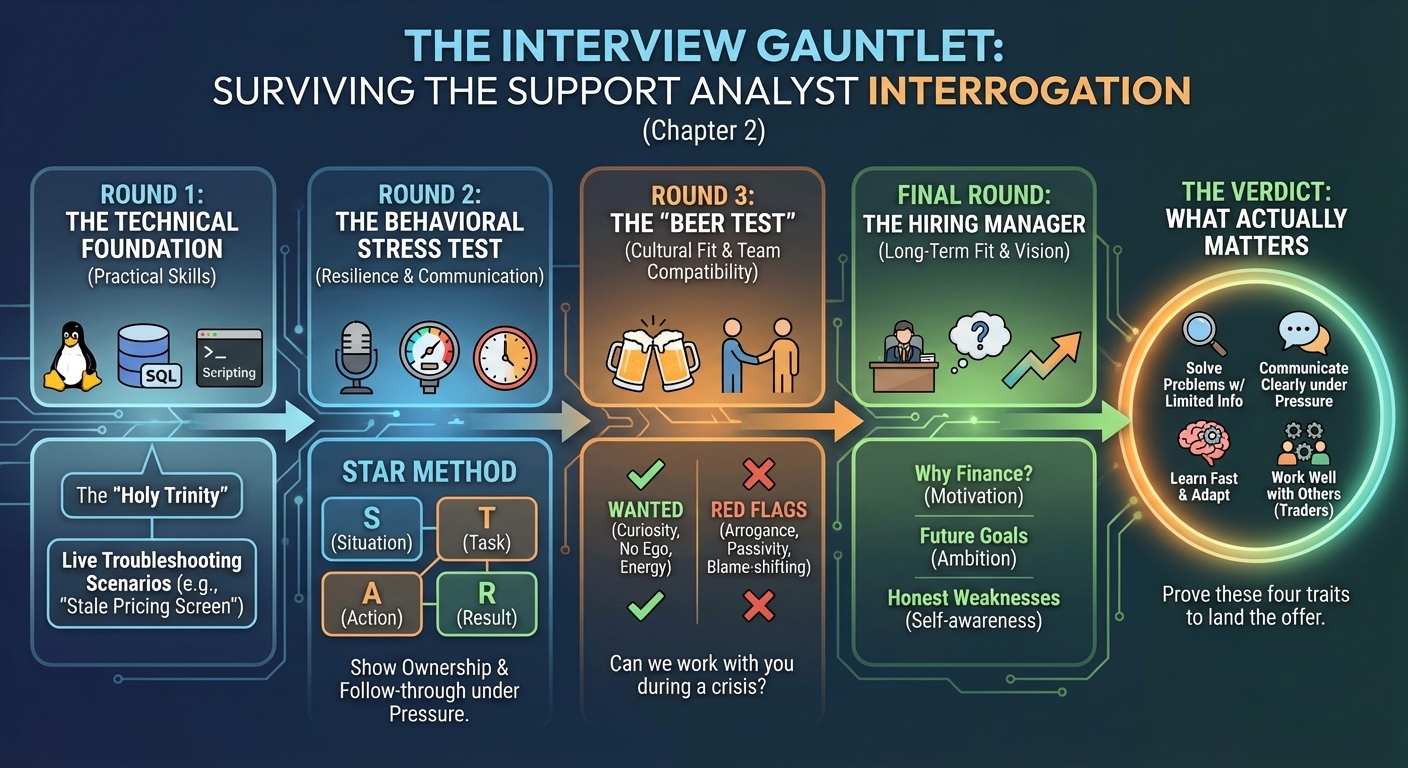
You've submitted your CV. You've passed the initial screen. Now comes the real test: surviving the Support Analyst interrogation.
Investment banking interviews aren't about algorithms or data structures. They're about proving you can handle the chaos when a $500 million trade goes missing at 2 AM and traders are screaming.
The process is brutal but predictable. Four rounds. Four tests. One verdict.
Let me walk you through each round and give you the survival guide.
Round 1: The Technical Foundation (Practical Skills)
This is where they test The Holy Trinity: Unix, SQL, and Scripting. You don't need to be an expert. You need to prove you can learn and troubleshoot under pressure.
The Holy Trinity Questions
Question 1: Unix File Navigation "How would you find all log files modified in the last 24 hours?"
Follow-up: "How would you search those files for errors?"
What they're testing: Can you navigate a Unix filesystem without a GUI? Can you troubleshoot when systems are down?
Question 2: SQL Data Investigation "You have two tables: trades and confirmations. Find trades that haven't been confirmed."
SELECT t.trade_id, t.trade_date, t.counterparty
FROM trades t
LEFT JOIN confirmations c ON t.trade_id = c.trade_id
WHERE c.trade_id IS NULL;
What they're testing: Can you find missing data? Can you think like a detective when trades go missing?
Question 3: Basic Scripting "Write a script that checks if a process is running. If not, restart it."
#!/bin/bash
PROCESS_NAME="trading_app"

if ps -ef | grep -v grep | grep "$PROCESS_NAME" > /dev/null
then
    echo "$PROCESS_NAME is running."
else
    echo "$PROCESS_NAME not running. Restarting..."
    /apps/trading/start.sh
fi
What they're testing: Can you automate repetitive tasks? Can you write code that won't break production?
Live Troubleshooting Scenarios
They'll give you real scenarios: "Stale Pricing Screen" - traders can't see current market prices.
Your approach: 1. Check monitoring system (Geneos) 2. Verify market data feeds (Bloomberg, Reuters) 3. Check database connectivity 4. Restart services if needed 5. Communicate status to traders
Pro Tip: If you don't know the exact syntax, talk through your logic. They care more about your troubleshooting process than perfect commands.
Round 2: The Behavioral Stress Test (Resilience & Communication)
This is where they test if you can handle the pressure of a trading floor. They use the STAR Method to dig into your past experiences.
The STAR Framework
Every answer follows this structure: - Situation: Set the context (15 seconds)- Task: What needed to be done (15 seconds)
- Action: What YOU did (45 seconds) - Result: The outcome (15 seconds)
Common Stress Test Questions
"Tell me about a time you had to troubleshoot a critical issue with limited information."
Example STAR Response:
Situation: "At my previous role, our main application went down during peak hours. Users couldn't access the system."
Task: "I had to diagnose and fix the issue quickly - we were losing revenue every minute."
Action: "I checked the monitoring dashboard - no obvious alerts. I SSH'd into the server and found the database connection pool was exhausted. I increased the pool size temporarily, then investigated the root cause. Found a memory leak in a recent code deployment. I rolled back the deployment and worked with developers to fix the leak."
Result: "System was restored in 20 minutes. We prevented further downtime and implemented better monitoring for connection pools."
"Describe a time you had to work with a difficult stakeholder."
Example STAR Response:
Situation: "A senior trader was frustrated because a report he needed was delayed by 2 hours due to a batch job failure."
Task: "I needed to fix the issue and manage his expectations while under pressure."
Action: "I acknowledged his frustration immediately and gave him a realistic timeline: 30 minutes to diagnose, 30 minutes to fix. I kept him updated every 15 minutes. I found the issue was a locked database table, killed the blocking session, and reran the job. I also documented the fix in our runbook."
Result: "Report delivered in 45 minutes. The trader appreciated the regular updates and later thanked me for keeping him informed. We implemented monitoring to catch table locks earlier."
"Tell me about a time you made a mistake. How did you handle it?"
Example STAR Response:
Situation: "During a system upgrade, I accidentally restarted the wrong server - the production server instead of the UAT server."
Task: "I needed to minimize downtime and communicate the error to stakeholders."
Action: "I immediately informed my manager and the affected desk. I brought the server back online within 3 minutes. I then conducted a post-mortem to understand how I made the mistake - the server naming convention was ambiguous. I proposed a new naming standard and implemented a confirmation prompt in our restart scripts."
Result: "Downtime was minimal (3 minutes). The team appreciated my honesty and proactive solution. We implemented the new naming standard across all environments, preventing future mistakes."
Key lesson: They want to see you own your mistakes, communicate transparently, and learn from failures.
The Assessment Centre (Graduate Schemes Only)
If you're going through the Officer route (graduate schemes), you'll face an Assessment Centre - a full-day evaluation with multiple exercises.
What to Expect
Duration: 6-8 hours (usually 9 AM - 5 PM)
Location: Bank's office or external venue
Format: Group exercises, individual presentations, technical tests, interviews
Exercise 1: Group Problem-Solving
The Setup: You're given a business case (e.g., "The trading platform is slow. Recommend solutions") and 45 minutes to discuss with 5-6 other candidates.
What they're watching: - Do you contribute ideas? - Do you listen to others? - Do you dominate or collaborate? - Can you build on others' suggestions?
How to succeed: - Contribute early (but don't dominate) - Listen actively ("That's a good point, and we could also...") - Keep time ("We have 10 minutes left, let's finalize our recommendation") - Be constructive (never say "That won't work" - say "What if we tried...")
Red flags: - Staying silent the entire time - Talking over others - Dismissing others' ideas - Not contributing to the final recommendation
Exercise 2: Individual Presentation
The Setup: You're given a technical topic (e.g., "Explain how a database works") and 30 minutes to prepare a 5-minute presentation.
What they're testing: - Can you explain technical concepts simply? - Can you structure your thoughts under pressure? - Can you handle questions?
How to succeed: - Use the 3-point structure: Introduction, 3 main points, Conclusion - Use analogies: "A database is like a library - tables are bookshelves, rows are books"- Practice beforehand: Have 3-4 technical topics ready (databases, networks, operating systems, cloud) - Handle questions confidently: If you don't know, say "I don't know the specifics, but I'd approach it by..."
Exercise 3: Numerical Reasoning Test
The Setup: 20-30 questions in 30 minutes. Interpreting charts, calculating percentages, analyzing data.
Example question: "Trading volume increased by 15% in Q1 and 20% in Q2. If Q1 volume was 1,000 trades, what was Q2 volume?"
Answer: Q1 = 1,000 × 1.15 = 1,150. Q2 = 1,150 × 1.20 = 1,380.
How to prepare: - Practice on JobTestPrep or AssessmentDay - Focus on percentages, ratios, and data interpretation - Bring a calculator (if allowed)
Exercise 4: Logical Reasoning Test
The Setup: Pattern recognition, sequences, deductive reasoning.
Example question: "If all traders use Bloomberg, and John is a trader, does John use Bloomberg?"
Answer: Yes (deductive reasoning).
How to prepare: - Practice on SHL or Kenexa practice tests - Focus on pattern recognition and logical sequences
Salary Negotiation (The Money Talk)
You've got the offer. Now comes the negotiation. Most candidates accept the first offer. Don't.
Know Your Market Value
Research before the offer: - Jobserve.com (UK contract rates) - Glassdoor (permanent salaries) - LinkedIn Salary (industry benchmarks) - CWJobs (UK tech salaries)
Typical ranges (London, 2024): - Graduate (0-1 year): £30k-£40k base - Analyst (1-3 years): £40k-£55k base - Senior Analyst (3-5 years): £55k-£70k base
Bonuses: 10-25% of base (discretionary)
The Negotiation Script
When they make the offer:
Recruiter: "We'd like to offer you £35,000 base plus bonus."
You: "Thank you, I'm excited about the role. Can I have 24 hours to review the offer?"
Why wait 24 hours? - Shows you're thoughtful, not desperate - Gives you time to research and prepare your counter - Creates slight tension (they want you to say yes)
Your counter (next day):
You: "I'm very interested in the role. Based on my research and the market rate for this position, I was expecting closer to £40,000. Is there flexibility on the base salary?"
Key phrases: - "Based on my research" (shows you've done homework) - "Market rate" (objective, not personal) - "Is there flexibility?" (not demanding, asking)
Possible outcomes:
- They increase: "We can do £38,000." → Accept or counter once more.
- They hold firm: "£35,000 is our final offer." → Negotiate other benefits (see below).
- They meet your ask: "We can do £40,000." → Accept.
If They Won't Budge on Salary
Negotiate other benefits:
- Sign-on bonus: "Can we add a £3,000 sign-on bonus?"
- Earlier salary review: "Can we schedule a 6-month review instead of 12 months?"
- Training budget: "Can I get £2,000/year for certifications and courses?"
- Extra holiday: "Can I get an extra 3 days annual leave?"
- Remote work: "Can I work from home 1-2 days per week?"
Pro tip: Banks are more flexible on one-time payments (sign-on bonus) than recurring costs (base salary).
When NOT to Negotiate
Don't negotiate if: - You're coming through FDM/MThree (rates are fixed) - It's a graduate scheme (structured pay bands) - You have no leverage (no other offers, no unique skills) - The offer is already at the top of the market range
Do negotiate if: - You have another offer - You have niche skills (Murex, Calypso, specific trading systems) - The offer is below market rate - You're moving from a higher-paying role
Red Flags in Job Offers (When to Walk Away)
Not all offers are good offers. Watch for these warning signs:
Red Flag #1: Vague Job Description
Warning sign: "You'll support various systems across the bank."
Why it's bad: You'll be a glorified help desk, not a specialist. No clear career path.
What to ask: "Which specific systems will I support? Which desk?"
Red Flag #2: Unrealistic On-Call Expectations
Warning sign: "On-call 24/7, every other week, no additional pay."
Why it's bad: Burnout within 6 months. No work-life balance.
What to ask: "What's the on-call rotation? Is there on-call pay or time-in-lieu?"
Acceptable: 1 week in 4-6, with on-call pay (£100-200/week) or time-in-lieu.
Red Flag #3: High Team Turnover
Warning sign: "The last three people in this role left within a year."
Why it's bad: Toxic manager, unrealistic expectations, or dead-end role.
What to ask: "Why did the previous person leave? What's the average tenure on the team?"
Red Flag #4: No Training or Onboarding
Warning sign: "You'll hit the ground running. We need someone who can start immediately."
Why it's bad: You'll be thrown into production support with no context. High chance of making costly mistakes.
What to ask: "What does the onboarding process look like? Will I shadow someone for the first few weeks?"
Red Flag #5: Unclear Reporting Structure
Warning sign: "You'll report to multiple managers across different teams."
Why it's bad: No clear accountability. Conflicting priorities. No one to advocate for your promotion.
What to ask: "Who is my direct manager? Who conducts my performance reviews?"
When to Walk Away
If you see 3+ red flags, decline the offer. A bad first role can set your career back 2-3 years.
It's better to wait for the right opportunity than to take a toxic role.
What They're Looking For
Show Ownership & Follow-through: You took charge. You didn't wait for someone else to fix it.
Communication Under Pressure: You kept stakeholders informed during the crisis.
Technical Competence: You knew where to look and what to check.
Learning from Failure: You implemented improvements to prevent future issues.
Round 3: The "Beer Test" (Cultural Fit & Team Compatibility)
This is the unspoken test. After assessing your technical and behavioral skills, they ask: "Can we work with you during a 12-hour crisis? Would we want to grab a beer with you after a brutal week?"
What They Want to See
✓ Curiosity: Do you ask good questions about the role and technology? ✓ No Ego: Can you admit when you don't know something? ✓ Energy: Do you seem genuinely interested in the work?
Red Flags to Avoid
✗ Arrogance: "I know everything about Unix" ✗ Passivity: Not asking questions at the end ✗ Blame-shifting: "It was the developer's fault"
Smart Questions to Ask
- "What's the on-call rotation like?"
- "What's the most challenging incident you've dealt with recently?"
- "What monitoring tools does the team use?"
- "How does the team handle knowledge sharing?"
The Key Question: "Can we work with you during a crisis?"
Your technical skills got you to this round. Your personality determines if you get the offer.
Final Round: The Hiring Manager (Long-Term Fit & Vision)
This is where a VP or Director assesses if you're a long-term investment for the team. They're looking beyond immediate skills to your potential and motivation.
The Big Three Questions
"Why Finance?"
Bad Answer: "Money." Good Answer: "I want to work on systems where downtime costs millions. Where I'm solving real problems under pressure and making a direct impact on the business."
"Future Goals?"
Bad Answer: "I don't know." Good Answer: "I want to become a senior analyst, then move into Business Analysis or DevOps. I want to understand the full technology stack from trading floor to infrastructure."
"Honest Weaknesses?"
Bad Answer: "I'm a perfectionist." (Everyone says this) Good Answer: "I sometimes dive too deep into troubleshooting before communicating updates. I've learned to set 30-minute check-in timers during incidents to keep stakeholders informed."
The Verdict: What Actually Matters
The interview isn't about being the smartest person in the room. It's about proving you have four core traits:
Solve Problems with Limited Information
You can troubleshoot when you don't have all the facts. You can make educated guesses and test hypotheses.
Communicate Clearly Under Pressure
You can explain technical issues to non-technical people. You can keep stakeholders informed during crises.
Learn Fast and Adapt
You can pick up new technologies quickly. You can adapt to changing requirements and systems.
Work Well with Others (Especially Traders)
You can collaborate with difficult personalities. You can handle stress without taking it personally.
If you can demonstrate these four traits across the four rounds, you'll get the offer.
My FDM Story: The Mercenary Route (2007)
I didn't have a First-Class degree from Oxford. I went to University of Bolton. Graduate schemes rejected me.
So I took the Mercenary route through FDM.
The Process: - Applied online (no cover letter needed) - Phone screen: 15 minutes, basic sanity check - Assessment day: aptitude tests, group exercise, interview - Offer within a week
The Deal: - £25,000 starting salary - 8 weeks intensive training (Unix, SQL, Finance) - 2-year contract bond - Deployment to ABN Amro as contractor
The Reality: - Lower salary than direct hires - But I got into a Tier 1 bank that would never have looked at my CV - After 2 years, I had experience that opened every door
The Mercenary route isn't glamorous. But it works.
Action Items: Interview Preparation
-
Master The Holy Trinity: Set up a Linux VM, practice SQL queries, write automation scripts
-
Prepare STAR Stories: Document 5-7 examples of problem-solving under pressure
-
Research the Bank: Know their divisions, recent technology initiatives, current challenges
-
Practice the Beer Test: Be curious, humble, and genuinely interested in the work
-
Prepare Smart Questions: Have 5-10 thoughtful questions about the role and team
The interview is just the beginning. Once you're in, the real learning starts.
Your First 90 Days: The Survival Roadmap
You've got the offer. You've accepted. Now comes the hardest part: proving you belong.
The first 90 days determine your trajectory. Succeed here, and you'll be on track for promotion. Struggle, and you'll spend years catching up.
Here's your roadmap.
Week 1-4: Foundation Phase (Absorb Everything)
Day 1-7: Orientation & Access
Your goals: - Get all system access (VPN, servers, databases, monitoring tools) - Meet your team and key stakeholders - Read all documentation (runbooks, system diagrams, incident logs)
What to do: - [ ] Set up laptop and development environment - [ ] Request access to all systems (submit tickets early - approvals take time) - [ ] Shadow a senior analyst for full day - [ ] Read last 3 months of incident reports - [ ] Attend desk meetings (even if you don't understand everything)
What NOT to do: - Don't touch production systems yet - Don't make suggestions (you don't know enough) - Don't skip documentation (boring but essential)
Success metric: By Day 7, you should know where to find logs, who to call for help, and what the top 5 systems are.
Day 8-14: Supervised Operations
Your goals: - Perform start-of-day checks with supervision - Handle first incident (with backup) - Learn the monitoring tools
What to do: - [ ] Run start-of-day checks with senior analyst watching - [ ] Take notes on every step (you'll forget) - [ ] Ask "why" for every check (understand the purpose) - [ ] Volunteer to handle next P3 incident (low-risk) - [ ] Document what you learn in personal notes
What NOT to do: - Don't restart services without asking - Don't assume you know the answer - Don't be afraid to ask "stupid" questions
Success metric: By Day 14, you should be able to run start-of-day checks independently and explain what each check does.
Day 15-21: Independent Monitoring
Your goals: - Run start-of-day checks solo - Monitor systems during market hours - Escalate appropriately
What to do: - [ ] Run start-of-day checks alone (senior analyst reviews) - [ ] Monitor dashboard during market hours - [ ] Practice escalation (when to call, who to call) - [ ] Start learning SQL queries for common issues - [ ] Build relationship with one trader (introduce yourself)
What NOT to do: - Don't panic when alerts fire (breathe, then act) - Don't skip escalation (better to over-communicate) - Don't ignore small issues (they become big issues)
Success metric: By Day 21, you should handle P3 incidents independently and know when to escalate P2/P1 issues.
Day 22-30: First Solo On-Call (With Backup)
Your goals: - Complete first on-call shift - Handle incidents with backup available - Build confidence
What to do: - [ ] Take first on-call shift (weeknight, not weekend) - [ ] Have senior analyst on backup (they're one call away) - [ ] Follow incident protocol religiously - [ ] Document everything you do - [ ] Debrief after shift (what went well, what didn't)
What NOT to do: - Don't try to be a hero (call for help early) - Don't make changes without approval - Don't forget to update stakeholders
Success metric: By Day 30, you should complete an on-call shift without major incidents or escalations.
Month 2-3: Building Credibility (Prove Your Value)
Your goals: - Automate first repetitive task - Document first runbook - Build relationships with traders - Become known as reliable
What to do: - [ ] Identify one repetitive task (e.g., daily log check) - [ ] Write script to automate it (Bash or Python) - [ ] Show script to senior analyst for review - [ ] Document script in runbook - [ ] Attend all desk meetings - [ ] Learn traders' names and what they trade - [ ] Respond to requests quickly (even if answer is "I don't know, let me find out") - [ ] Volunteer for projects (system upgrades, documentation)
What NOT to do: - Don't automate critical tasks without testing - Don't skip documentation (future you will thank you) - Don't avoid traders (they're your customers)
Success metric: By Month 3, you should have automated at least one task, documented it, and be recognized by traders as "the reliable one."
Day 90: Self-Assessment Checkpoint
Ask yourself these questions:
Technical Competence: - [ ] Can I handle P1 incidents independently? - [ ] Do I know the top 10 Unix/SQL commands by heart? - [ ] Have I automated at least one task? - [ ] Can I read logs and identify errors quickly?
Business Knowledge: - [ ] Do I understand what each desk trades? - [ ] Can I explain the trade lifecycle? - [ ] Do I know the difference between a swap and an option? - [ ] Can I explain business impact when systems fail?
Relationships: - [ ] Do I know the key stakeholders (traders, managers, DBAs)? - [ ] Have I built rapport with at least 2 traders? - [ ] Does my team trust me to handle incidents? - [ ] Do people come to me with questions?
Career Readiness: - [ ] Am I ready for promotion discussions (in 6-12 months)? - [ ] Have I identified areas to improve? - [ ] Do I have a learning plan (certifications, courses)? - [ ] Am I happy in this role, or do I want to pivot?
If you answered "yes" to 12+ questions: You're on track. Keep going.
If you answered "yes" to 8-11 questions: You're doing okay, but need to focus on weak areas.
If you answered "yes" to <8 questions: You're struggling. Talk to your manager. Get help.
The Reality: It's Hard
The first 90 days are brutal. You'll feel overwhelmed. You'll make mistakes. You'll wonder if you're cut out for this.
That's normal.
Every Support Analyst goes through this. The ones who succeed are the ones who: - Ask for help early - Document everything - Stay calm under pressure - Learn from mistakes - Don't give up
You've got this.
Next up: Chapter 3 - The Engine Room. The Unix commands that will save your career when everything breaks.