Chapter 9: The Promotion Ladder (Career Progression)
"You don't climb by waiting. You climb by delivering, learning, and making yourself indispensable." — VP, Technology
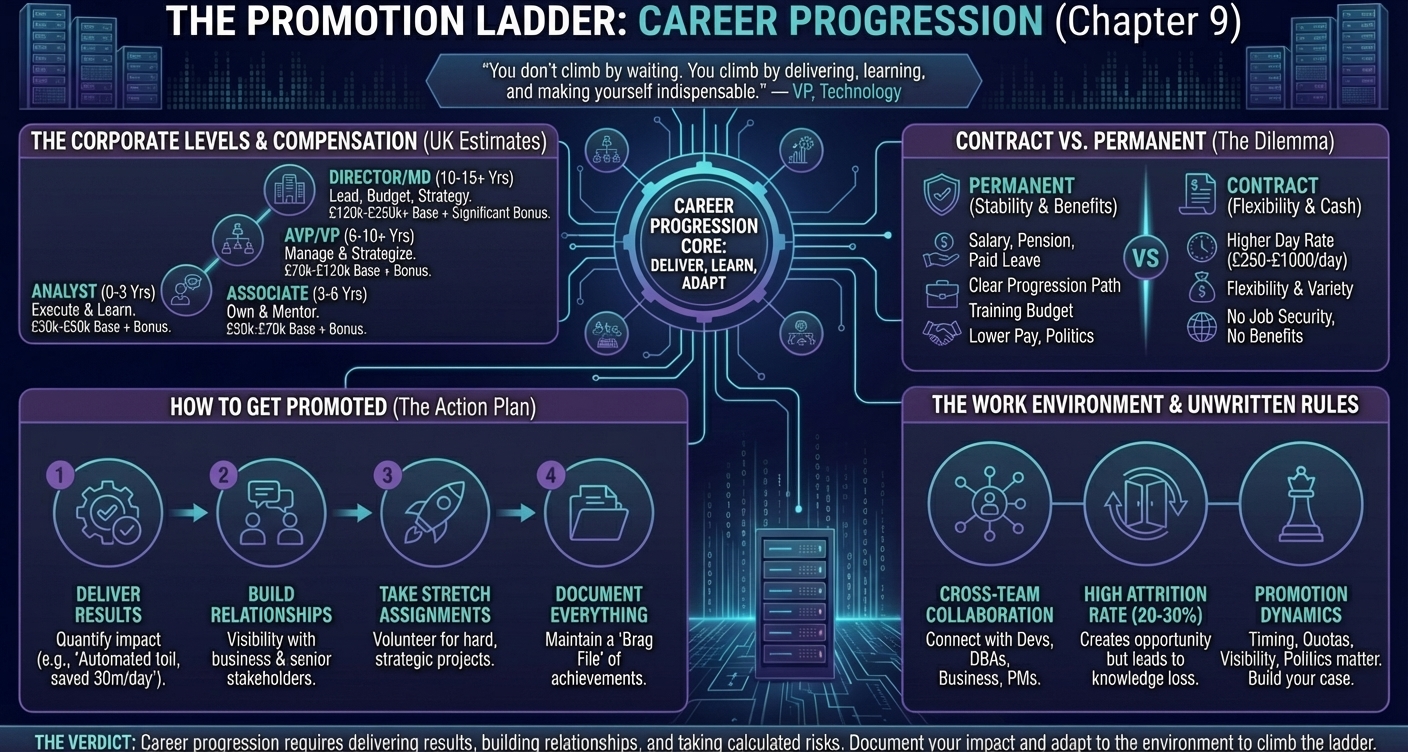
You've survived the first 2 years. You know the tools, you've managed incidents, and you understand the business. Now what?
This chapter covers career progression in Front Office Support: the corporate ladder, the contract vs. permanent decision, and how to advance.
The Corporate Levels
Investment banks have a standard hierarchy. Here's what each level means:
Analyst (Entry Level)
Years of experience: 0-3
What you do:
- Execute tasks assigned by senior team members.
- Handle day-to-day support (Start-of-Day checks, incident response).
- Learn the systems and the business.
Salary (UK, approximate): £30k-£50k base + bonus
How to advance: Deliver consistently. Show you can handle incidents independently. Start automating repetitive tasks.
Associate (Mid-Level)
Years of experience: 3-6
What you do:
- Own specific systems or desks.
- Lead incident response for your area.
- Mentor junior analysts.
- Participate in projects (system upgrades, migrations).
Salary (UK, approximate): £50k-£70k base + bonus
How to advance: Take ownership. Volunteer for projects. Build relationships with the business. Document your impact (e.g., "Reduced incident response time by 40%").
Assistant Vice President (AVP) / Vice President (VP)
Years of experience: 6-10+
What you do:
- Manage a team of analysts/associates.
- Define support strategy for your area.
- Interface with senior business stakeholders.
- Drive process improvements and automation initiatives.
Salary (UK, approximate): £70k-£100k+ base + bonus
How to advance: Demonstrate leadership. Deliver high-impact projects. Build a reputation as the "go-to" person for your domain.
Director / Managing Director (MD)
Years of experience: 10-15+
The Director Levels (Varies by Bank):
Some banks have multiple Director levels:
- Associate Director: Entry-level director. Manages a small team or specialized area. Still hands-on with technical work.
- Executive Director: Senior director. Manages multiple teams or a critical function. More strategic, less hands-on.
- Managing Director: Top of the ladder. Oversees entire divisions. Budget authority. Vendor negotiations. Board-level reporting.
What you do:
- Associate Director: Lead a team of 3-5 people. Own a specific domain (e.g., Fixed Income Support). Still involved in major incidents.
- Executive Director: Manage managers. Define support strategy across multiple desks. Drive transformation initiatives (e.g., cloud migration).
- Managing Director: Strategic oversight of entire support function. Budget management (£millions). Vendor relationships. Cross-divisional initiatives.
Salary (UK, approximate):
- Associate Director: £80k-£120k base + bonus
- Executive Director: £100k-£150k base + bonus
- Managing Director: £150k-£250k+ base + significant bonus (can double total comp)
Reality check: Very few Support Analysts reach MD. Most either pivot to other roles (see Chapter 10) or stay at VP/Director level. The jump from VP to Director requires demonstrating business impact, not just technical excellence.
Contract vs. Permanent: The Mercenary's Dilemma
One of the biggest decisions you'll face: Should I go contract or stay permanent?
Permanent Roles
Pros:
- Stability: Salary, benefits, pension, paid leave.
- Career progression: Clear path from Analyst → Associate → VP.
- Training budget: Banks invest in permanent staff (courses, certifications).
- Internal mobility: Easier to move between teams or divisions.
Cons:
- Lower day rate: You're paid less than contractors for the same work.
- Politics: Promotions can be slow. You're competing with colleagues.
- Less flexibility: Harder to leave if the project is boring.
When to choose permanent:
- You want long-term stability.
- You're early in your career and need to build skills.
- You value benefits (pension, healthcare, bonuses).
Contract Roles
Pros:
- Higher day rate: Contractors earn 30-50% more than permanent staff.
- Flexibility: Finish a project, move to the next one.
- Variety: Work at different banks, different systems, different challenges.
- No politics: You're hired to deliver, not to navigate office politics.
Cons:
- No job security: Contracts can be terminated with 1-2 weeks' notice.
- No benefits: No pension, no paid leave, no bonuses.
- IR35 (UK): Tax rules that can reduce your take-home pay if you're "inside IR35."
- Harder to get mortgages: Banks prefer permanent employment history.
When to choose contract:
- You're experienced (5+ years) and confident in your skills.
- You want to maximize earnings in the short term.
- You're comfortable with uncertainty.
My Experience
I spent most of my career as permanent because I valued:
- Learning opportunities (the banks paid for training).
- Building deep domain knowledge (staying in one area long enough to become an expert).
- Project completion (I moved when projects finished, not when contracts ended).
But I know contractors who earned significantly more and loved the variety. It's a personal choice.
The Work Environment (The Reality Nobody Tells You)
Beyond titles and salaries, here's what day-to-day life looks like at each level.
Cross-Team Collaboration
Support Analysts don't work in isolation. You'll interact with:
- Developers: Escalating bugs, coordinating releases.
- DBAs: Troubleshooting database issues, requesting schema changes.
- Network team: Diagnosing connectivity issues.
- Security team: Implementing firewall rules, investigating breaches.
- Business Analysts: Gathering requirements, documenting processes.
- Project Managers: Reporting status, managing dependencies.
- The Business: Traders, risk managers, operations.
Why it matters: Your ability to work across teams determines your effectiveness. The best Support Analysts are connectors—they know who to call and how to get things done.
Real-World Example (UK Bank, 2014): A pricing engine was slow. I coordinated with:
- Developers: To profile the code.
- DBAs: To check database performance.
- Network team: To verify latency.
Root cause: A misconfigured network switch. Fixed in 2 hours because I knew who to involve.
Strategic Projects
As you advance, you'll spend less time on day-to-day support and more on strategic initiatives:
- System migrations: Moving from legacy platforms to modern systems.
- Cloud adoption: Migrating on-premise systems to AWS/Azure.
- Automation: Building self-service tools for the business.
- Regulatory compliance: Implementing new reporting requirements (MiFID II, Dodd-Frank).
Why it matters: Projects are how you get promoted. They're visible to senior management and demonstrate your ability to deliver beyond "keeping the lights on."
Real-World Example (UK Bank, 2013-2015): I spent 2 years on a post-2008 regulatory project. It was tedious (lots of documentation), but it got me exposure to MDs and led to my promotion to Associate.
Attrition Rate (The Revolving Door)
Investment banking has high turnover. Expect:
- 20-30% annual attrition in support teams.
- Higher for contractors (they move between projects).
- Lower for senior staff (VPs and Directors tend to stay longer).
Why people leave:
- Burnout: On-call rotations, high-pressure incidents.
- Better opportunities: Higher pay elsewhere, less stressful roles.
- Boredom: After 3-5 years, you've seen it all.
- Layoffs: Banks restructure. Support teams are often first to be cut.
Why it matters: High attrition means:
- Opportunities for advancement: People leave, creating openings.
- Knowledge loss: You'll constantly be training new team members.
- Job insecurity: Don't get too comfortable.
Real-World Example (Swiss Bank, 2011): In my first year, 4 out of 8 team members left. I went from junior analyst to owning critical systems within 18 months because there was nobody else.
Promotion Dynamics (The Unspoken Rules)
Promotions aren't just about performance. Politics matter.
The Reality:
- Timing: Promotions happen during annual review cycles (usually Q1). If you miss the window, you wait another year.
- Quotas: Managers have limited "promotion budget." If 3 people deserve promotion but there's only budget for 1, someone gets left out.
- Visibility: If senior management doesn't know who you are, you won't get promoted past Associate.
- Favoritism: Managers promote people they like. Build a good relationship with your manager.
How to navigate:
- Ask early: In Q3, ask your manager: "Am I on track for promotion in Q1?"
- Build a case: Document your impact. Make it easy for your manager to justify your promotion.
- Get external validation: If the business (traders, desk heads) advocates for you, it's harder for your manager to say no.
- Be willing to leave: Sometimes the only way to get promoted is to get an offer elsewhere and use it as leverage (or just leave).
Remuneration Deep Dive (What You'll Actually Earn)
Let's talk numbers. Salaries vary by bank, location, and market conditions. Here's a detailed breakdown.
Permanent Roles (London, 2024 estimates)
Analyst:
- Junior (0-1 year): £30k-£40k base + 10-15% bonus = £33k-£46k total
- Mid (1-2 years): £40k-£50k base + 15-20% bonus = £46k-£60k total
- Senior (2-3 years): £50k-£60k base + 20-25% bonus = £60k-£75k total
Associate:
- Junior (3-4 years): £60k-£70k base + 20-25% bonus = £72k-£88k total
- Senior (5-6 years): £70k-£85k base + 25-30% bonus = £88k-£110k total
Vice President:
- AVP (6-8 years): £85k-£100k base + 30-40% bonus = £110k-£140k total
- VP (8-10 years): £100k-£120k base + 40-50% bonus = £140k-£180k total
Director:
- Associate Director: £120k-£140k base + 50-60% bonus = £180k-£224k total
- Executive Director: £140k-£170k base + 60-80% bonus = £224k-£306k total
- Managing Director: £170k-£250k+ base + 80-100%+ bonus = £306k-£500k+ total
Contract Roles (London, day rates, 2024 estimates)
Analyst Level: £250-£400/day (£65k-£104k annually, assuming 260 working days)
Associate Level: £400-£550/day (£104k-£143k annually)
VP Level: £550-£750/day (£143k-£195k annually)
Director Level: £750-£1000/day (£195k-£260k annually)
Note: Contractors earn more per day but have no benefits, no paid leave, and no bonus. Factor in 20-25 days of unpaid leave and the gap narrows.
Regional Differences
New York:
- Add 20-30% to London salaries.
- Example: Analyst in London = £40k. Analyst in NY = $65k-70k.
- But: Higher cost of living (rent, taxes).
Singapore / Hong Kong:
- Comparable to London, sometimes higher for senior roles.
- Tax advantages (lower income tax in Singapore).
Sydney:
- 10-20% lower than London.
- Better work-life balance (less on-call pressure).
Frankfurt / Zurich:
- Competitive with London.
- Language skills (German) often required.
- Higher cost of living (especially Zurich).
Bonus Structures
Bonuses are discretionary and vary by:
- Bank performance: If the bank has a bad year, bonuses shrink.
- Desk performance: If your desk makes money, your bonus is higher.
- Individual performance: Your manager's assessment.
Typical bonus ranges:
- Analyst: 10-25% of base.
- Associate: 20-30% of base.
- VP: 30-50% of base.
- Director: 50-100%+ of base.
Reality check: Don't count on the high end. Budget for the low end.
Contract vs Permanent (Total Comp Comparison)
Example: Mid-level Associate (5 years experience)
Permanent:
- Base: £70k
- Bonus: £17.5k (25%)
- Pension: £3.5k (5% employer contribution)
- Benefits: £2k (healthcare, gym, etc.)
- Total: £93k
Contract:
- Day rate: £500
- Working days: 240 (after 20 days unpaid leave)
- Total: £120k
- Minus: Accountant fees (£2k), insurance (£1k), pension (self-funded £6k)
- Net: £111k
Difference: £18k more as a contractor, but with more risk and no job security.
How to Get Promoted
Promotions don't happen automatically. Here's what actually works:
Deliver Results
What it means: Solve problems. Reduce incidents. Automate toil.
Example: At the UK bank, I automated the Start-of-Day checks, saving the team 30 minutes every morning. I documented the time saved and presented it during my performance review.
Lesson: Quantify your impact. "I worked hard" doesn't get you promoted. "I reduced incident response time by 40%" does.
Build Relationships
What it means: Make yourself known to the business, not just your manager.
Example: At the Swiss bank, I regularly attended the desk's morning meetings. I learned what they cared about and proactively fixed issues before they became incidents.
Lesson: The business has more influence than you think. If the desk head says "We need this person," you're getting promoted.
Take on Stretch Assignments
What it means: Volunteer for projects outside your comfort zone.
Example: At the Japanese bank, I volunteered to write the Licence to Operate (LTO) documents for regulatory compliance. It was tedious, but it got me exposure to senior management.
Lesson: Promotions go to people who solve hard problems, not people who stay in their lane.
Document Everything
What it means: Keep a "brag file" of your accomplishments.
Example: I kept a running list of:
- Major incidents I resolved.
- Automation scripts I wrote.
- Projects I delivered.
- Positive feedback from stakeholders.
During performance reviews, I had concrete evidence of my contributions.
Lesson: Your manager is busy. Make it easy for them to justify your promotion.
The Plateau (When Promotions Stop)
At some point, promotions slow down. You might stay at Associate or VP for years. This is normal.
Why it happens:
- Limited headcount: There are only so many VP or Director roles.
- Skill ceiling: You've maxed out your technical skills. Further advancement requires leadership and strategy.
- Market conditions: During downturns, promotions freeze.
What to do:
- Pivot to a new role (see Chapter 10).
- Move to a different bank (sometimes the only way to get promoted is to leave).
- Accept it (not everyone wants to be a Director. VP is a great place to be if you love the technical work).
The Verdict
Career progression in Front Office Support is achievable, but it requires:
- Delivering results (not just doing your job).
- Building relationships (with the business and senior management).
- Taking risks (volunteering for hard projects).
Action Items:
- Understand the levels: Know what's expected at each stage.
- Choose your path: Contract or permanent? Both are valid.
- Document your impact: Keep a brag file. Update it monthly.
- Ask for feedback: Don't wait for annual reviews. Ask your manager quarterly: "What do I need to do to get promoted?"
If you do these things, you'll climb faster than your peers.
Next up: Chapter 10 - Exfiltration (Exit Strategies).