Chapter 10: Exfiltration (Exit Strategies)
"Support is a great foundation. But it doesn't have to be your destination." — Former Support Analyst, now SRE
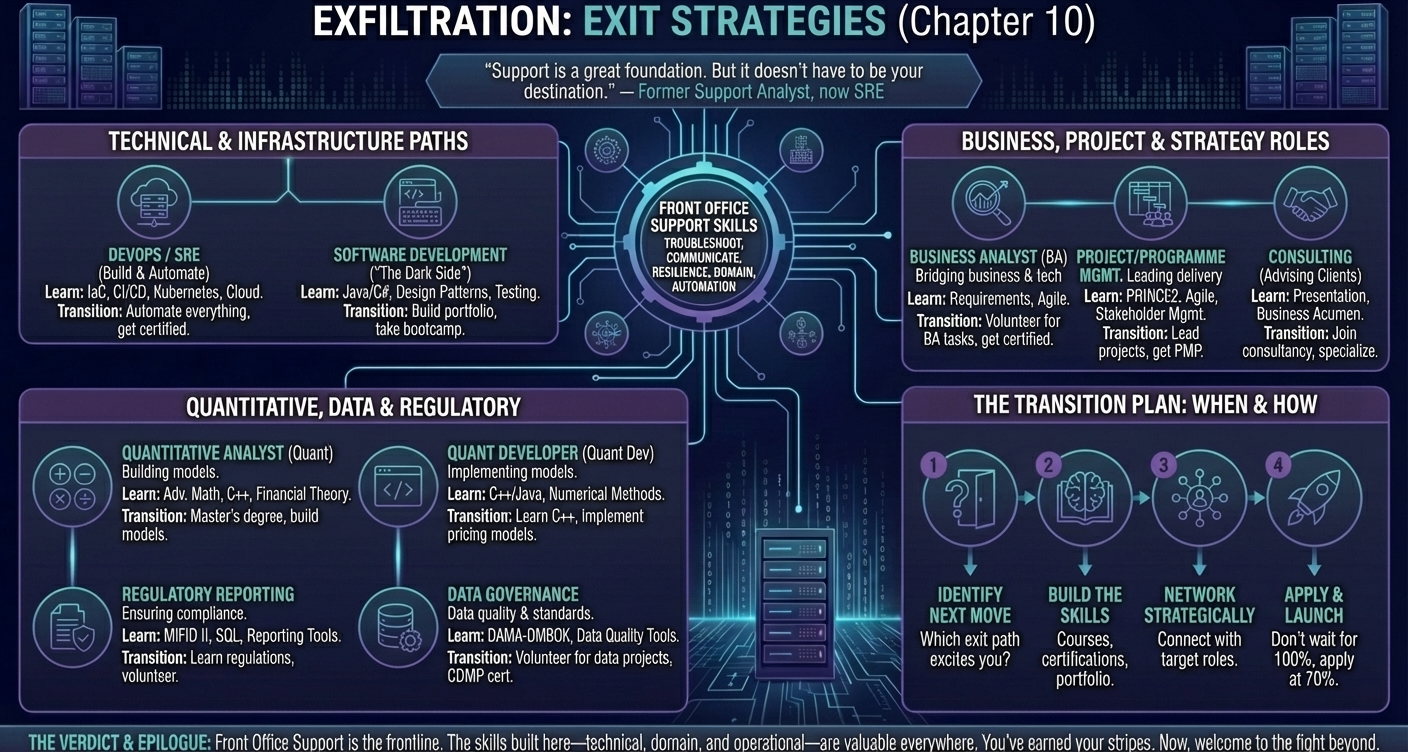
You've climbed the ladder. You're a VP. You've mastered the tools, the domain, the politics. But maybe you're tired of being woken up at 3 AM. Maybe you want to build systems instead of fixing them. Maybe you just want a change.
This chapter covers exit strategies—the alternative career paths that leverage your Front Office Support experience.
Why Leave Support?
Support is rewarding, but it has limits:
- Reactive work: You're always firefighting, rarely building.
- On-call fatigue: Night shifts and weekend rotations wear you down.
- Career ceiling: VP is often the end of the road unless you pivot.
The good news: Your skills are highly transferable. You understand systems, you know how to troubleshoot, and you've worked under pressure. That's valuable everywhere.
Exit Path 1: DevOps / Site Reliability Engineering (SRE)
What it is: Building and automating infrastructure. Focus on reliability, scalability, and deployment pipelines.
Salary Range (London, 2024): - Junior SRE: £50k-£70k - Mid-level SRE: £70k-£90k - Senior SRE: £90k-£120k - Principal SRE: £120k-£150k+
Transition Timeline: 6-12 months - Months 1-3: Learn Docker and Kubernetes basics - Months 4-6: Get AWS Certified Solutions Architect - Months 7-9: Build portfolio (automate deployments, create CI/CD pipelines) - Months 10-12: Apply for junior SRE roles
Why Support Analysts are good at this:
- You already troubleshoot production systems.
- You understand monitoring, alerting, and incident management.
- You've written automation scripts.
What you need to learn:
- Infrastructure as Code (Terraform, CloudFormation).
- CI/CD pipelines (Jenkins, GitLab CI, GitHub Actions).
- Containerization (Docker, Kubernetes).
- Cloud platforms (AWS, Azure, GCP).
My experience: I transitioned to DevOps at a government agency in 2019. My support background was perfect for SRE work—I knew how systems failed and how to make them resilient.
How to make the switch:
- Automate everything in your current role (build a portfolio of scripts).
- Learn Kubernetes (it's the industry standard).
- Get certified (AWS Certified Solutions Architect, CKA for Kubernetes).
- Apply for SRE roles at fintech companies or cloud-native startups.
Exit Path 2: Business Analyst (BA)
What it is: Bridging the gap between business and technology. Gathering requirements, writing specifications, managing stakeholder expectations.
Salary Range (London, 2024): - Junior BA: £40k-£55k - Mid-level BA: £55k-£70k - Senior BA: £70k-£90k - Lead BA: £90k-£110k
Transition Timeline: 3-6 months - Months 1-2: Get ISEB/BCS Business Analysis Foundation cert - Months 3-4: Volunteer for BA work (write specs, gather requirements) - Months 5-6: Apply for BA roles in financial services
Why Support Analysts are good at this:
- You already speak the language of the business (you've supported traders).
- You understand the trade lifecycle and domain concepts.
- You're used to translating technical issues into business impact.
What you need to learn:
- Requirements gathering (workshops, interviews, user stories).
- Documentation (functional specs, process flows, use cases).
- Agile methodologies (Scrum, Kanban).
My experience: I worked as a BA at a Japanese bank in 2012. I wrote Licence to Operate (LTO) documents for regulatory compliance. My support background helped me understand what the systems actually did, not just what they were supposed to do.
How to make the switch:
- Volunteer for BA work in your current role (write runbooks, document processes).
- Get certified (ISEB/BCS Business Analysis Foundation).
- Apply for BA roles in financial services (your domain knowledge is gold).
Exit Path 3: Project Management / Programme Management
What it is: Leading projects from initiation to delivery. Managing timelines, budgets, and stakeholders.
Salary Range (London, 2024): - Project Coordinator: £40k-£55k - Project Manager: £55k-£75k - Senior PM: £75k-£95k - Programme Manager: £95k-£120k
Transition Timeline: 6-12 months - Months 1-3: Get PRINCE2 Foundation or PMP certification - Months 4-6: Lead small project in current role - Months 7-9: Get PRINCE2 Practitioner or Agile cert - Months 10-12: Apply for PMO or junior PM roles
Why Support Analysts are good at this:
- You've managed incidents (which are mini-projects under pressure).
- You know how to coordinate across teams (dev, ops, business).
- You understand dependencies and risk.
What you need to learn:
- Project management methodologies (Waterfall, Agile, PRINCE2).
- Stakeholder management (managing up, managing sideways).
- Budget and resource planning.
How to make the switch:
- Lead a project in your current role (system migration, tool rollout).
- Get certified (PMP, PRINCE2, Agile certifications).
- Apply for PMO roles (Project Management Office) in banks.
Exit Path 4: Software Development (The "Dark Side")
What it is: Writing code to build new systems instead of supporting existing ones.
Salary Range (London, 2024): - Junior Developer: £35k-£50k - Mid-level Developer: £50k-£70k - Senior Developer: £70k-£95k - Lead Developer: £95k-£120k
Transition Timeline: 12-24 months - Months 1-6: Learn programming language (Java/Python/C#) - Months 7-12: Build portfolio (3-5 projects on GitHub) - Months 13-18: Contribute to open source, attend meetups - Months 19-24: Apply for junior dev roles (expect pay cut initially)
Why Support Analysts can do this:
- You've written scripts (Python, Bash).
- You understand how systems work end-to-end.
- You know what makes software maintainable (because you've had to maintain it).
What you need to learn:
- A programming language (Java, C#, Python, Go).
- Software design patterns (MVC, microservices).
- Testing (unit tests, integration tests).
- Version control (Git workflows, code reviews).
Reality check: This is the hardest pivot. You're competing with Computer Science grads who've been coding for years.
How to make the switch:
- Build a portfolio (contribute to open-source projects, build a side project).
- Take a bootcamp (if you need structured learning).
- Apply for junior dev roles (be prepared to take a pay cut initially).
Exit Path 5: Consulting
What it is: Advising clients on technology strategy, implementation, or operations.
Salary Range (London, 2024): - Consultant: £50k-£70k - Senior Consultant: £70k-£95k - Manager: £95k-£120k - Director: £120k-£180k+
Transition Timeline: 6-12 months - Months 1-3: Build presentation skills, create case studies - Months 4-6: Network with consultancies (Big 4, boutiques) - Months 7-9: Specialize (trading systems, regulatory compliance) - Months 10-12: Apply for consultant roles
Why Support Analysts are good at this:
- You've worked at multiple banks (if you've moved around).
- You understand best practices and anti-patterns.
- You can diagnose issues quickly.
What you need to learn:
- Presentation skills (selling your ideas to clients).
- Business acumen (understanding ROI, cost-benefit analysis).
- Networking (building a client base).
How to make the switch:
- Join a consultancy (Big 4, boutique firms).
- Specialize (e.g., "Trading systems expert" or "Regulatory compliance specialist").
- Build a reputation (speak at conferences, write articles).
Exit Path 6: Quantitative Analyst (Quant)
What it is: Building mathematical models to price derivatives, manage risk, or develop trading strategies. This is the "rocket scientist" role.
Why Support Analysts can do this:
- You understand the products (options, swaps, exotics).
- You've seen how pricing models work in production.
- You know what traders actually need (not just what textbooks say).
What you need to learn:
- Advanced mathematics (stochastic calculus, partial differential equations).
- Statistics (time series analysis, regression, Monte Carlo methods).
- Programming (C++, Python, R for quantitative work).
- Financial theory (Black-Scholes, interest rate models, volatility modeling).
Reality check: This is the hardest pivot. Most quants have PhDs in mathematics, physics, or engineering. You're competing with people who've spent 8+ years in academia.
How to make the switch:
- Get a Master's degree (Financial Engineering, Quantitative Finance, or Computational Finance).
- Learn C++ (it's the language of quant finance).
- Build models (replicate Black-Scholes, build a Monte Carlo pricer).
- Apply for junior quant roles (or start as a Quantitative Developer).
War story: I worked with a Support Analyst who transitioned to a quant role. He had a Physics degree, taught himself C++, and spent 2 years building pricing models in his spare time. He eventually joined a hedge fund as a junior quant. It took him 3 years and a lot of late nights.
Exit Path 7: Quantitative Developer (Quant Dev)
What it is: Implementing quants' models in production code. You're the bridge between the mathematician and the trading system.
Salary Range (London, 2024): - Junior Quant Dev: £60k-£80k - Mid-level Quant Dev: £80k-£110k - Senior Quant Dev: £110k-£150k - Lead Quant Dev: £150k-£200k+
Transition Timeline: 12-18 months - Months 1-6: Learn C++ (focus on performance) - Months 7-12: Implement pricing models (Black-Scholes, Monte Carlo) - Months 13-15: Contribute to QuantLib or similar - Months 16-18: Apply for Quant Dev roles
Why Support Analysts are good at this:
- You understand production systems (performance, reliability, monitoring).
- You know how to optimize code (you've debugged slow queries).
- You've worked with quants and traders (you speak both languages).
What you need to learn:
- C++ or Java (production-grade code, not just scripts).
- Numerical methods (finite difference, Monte Carlo, binomial trees).
- Performance optimization (low-latency code, memory management).
- Financial mathematics (enough to understand what the quants want).
Difference from Quant Analyst: Quants design models. Quant Devs implement them. You don't need a PhD, but you need strong coding skills.
How to make the switch:
- Learn C++ (focus on performance and memory management).
- Implement pricing models (Black-Scholes, binomial trees, Monte Carlo).
- Contribute to open-source quant libraries (QuantLib is a good start).
- Apply for Quant Dev roles (your support background is an advantage).
My take: This is more achievable than becoming a Quant Analyst. You don't need a PhD, just strong coding skills and domain knowledge. If you've supported pricing systems, you're already halfway there.
Exit Path 8: Regulatory Reporting
What it is: Ensuring the bank complies with financial regulations (MiFID II, Dodd-Frank, EMIR, Basel III). You extract data, generate reports, and submit them to regulators.
Why Support Analysts are good at this:
- You understand the data (you've queried trade databases).
- You know the systems (you've supported them).
- You can troubleshoot data issues (missing trades, incorrect valuations).
What you need to learn:
- Regulatory frameworks (MiFID II, EMIR, Dodd-Frank, Basel III).
- Data extraction (SQL, ETL processes).
- Reporting tools (Tableau, Power BI, custom reporting frameworks).
- Compliance processes (audit trails, data lineage, reconciliation).
Why this field is growing: Post-2008 financial crisis, regulators demand more transparency. Banks need armies of people to generate regulatory reports. It's not glamorous, but it's stable and well-paid.
How to make the switch:
- Learn the regulations (read MiFID II and EMIR documentation).
- Volunteer for regulatory projects in your current role.
- Get certified (ICA Diploma in Regulatory Compliance).
- Apply for Regulatory Reporting roles (banks, consultancies, regulators).
War story: A colleague moved from Support to Regulatory Reporting at a Swiss bank. He spent 6 months learning MiFID II, then joined the Reg Reporting team. His support background was perfect—he knew where the data lived and how to extract it. He's now a VP in Compliance.
Exit Path 9: Data Governance
What it is: Ensuring data quality, consistency, and compliance across the organization. You define data standards, manage metadata, and enforce data policies.
Why Support Analysts are good at this:
- You've dealt with data issues (missing reference data, incorrect prices).
- You understand data lineage (where data comes from, where it goes).
- You know the impact of bad data (failed trades, incorrect risk calculations).
What you need to learn:
- Data governance frameworks (DAMA-DMBOK, DCAM).
- Data quality tools (Informatica, Collibra, Alation).
- Metadata management (data dictionaries, data catalogs).
- Regulatory requirements (GDPR, BCBS 239).
Why this field is growing: Banks are drowning in data. They need people to ensure data is accurate, consistent, and compliant. It's a growing field with good career prospects.
How to make the switch:
- Learn data governance principles (read DAMA-DMBOK).
- Volunteer for data quality projects in your current role.
- Get certified (CDMP - Certified Data Management Professional).
- Apply for Data Governance roles (banks, consultancies, tech companies).
My take: This is an underrated exit path. It's less technical than DevOps, less mathematical than Quant, but it leverages your domain knowledge and data skills. If you've supported trading systems, you understand data better than most.
Exit Path 10: Project Management Office (PMO) Support
What it is: Supporting the PMO by tracking project progress, managing documentation, and coordinating across teams. It's the entry-level path to Project Management.
Why Support Analysts are good at this:
- You're organized (you manage incidents and track issues).
- You understand dependencies (you've coordinated across teams).
- You can communicate with technical and non-technical people.
What you need to learn:
- Project management tools (MS Project, Jira, Confluence).
- Reporting (status reports, dashboards, risk registers).
- Agile methodologies (Scrum, Kanban).
How to make the switch:
- Volunteer for PMO work in your current role (track project milestones, update documentation).
- Get certified (PRINCE2 Foundation, Agile certifications).
- Apply for PMO Analyst roles (banks, consultancies).
My take: This is the easiest pivot. PMO roles are everywhere, and your support background is a good fit. It's not as technical as DevOps, but it's a solid path to Project Management.
The Skills That Transfer
No matter which path you choose, these skills from Support will serve you:
- Troubleshooting: Breaking down complex problems.
- Communication: Explaining technical issues to non-technical people.
- Resilience: Staying calm under pressure.
- Domain knowledge: Understanding finance and trading.
- Automation: Writing scripts to reduce toil.
When to Make the Move
Signs it's time to leave Support:
- You're bored (you can troubleshoot incidents in your sleep).
- You're burned out (the on-call rotations are killing you).
- You've hit the ceiling (no more promotions available).
- You want to build, not fix.
Signs you should stay:
- You still enjoy the work.
- You're learning new systems or domains.
- You're being promoted regularly.
- You value the stability and benefits.
Skills Gap Analysis Template
Use this framework to plan your transition to any exit path.
Step 1: Current Skills Inventory
Technical Skills (Rate 1-5: 1=Beginner, 5=Expert) - Unix/Linux: ___/5 - SQL: ___/5 - Scripting (Bash/Python): ___/5 - Monitoring tools: ___/5 - Incident management: ___/5 - Cloud platforms (AWS/Azure): ___/5 - Containerization (Docker/Kubernetes): ___/5 - Programming (Java/C++/C#): ___/5 - CI/CD pipelines: ___/5 - Infrastructure as Code: ___/5
Domain Knowledge (Rate 1-5) - Trading systems: ___/5 - Financial products (derivatives, FX, equities): ___/5 - Trade lifecycle: ___/5 - Risk management: ___/5 - Regulatory requirements: ___/5
Soft Skills (Rate 1-5) - Communication (technical to non-technical): ___/5 - Stakeholder management: ___/5 - Project management: ___/5 - Presentation skills: ___/5 - Documentation: ___/5 - Troubleshooting under pressure: ___/5
Step 2: Target Role Requirements
Choose your exit path (e.g., DevOps/SRE):
Required Skills (Must have): - Example for DevOps: Kubernetes (⅘), AWS (⅘), CI/CD (⅘), Scripting (⅘)
Preferred Skills (Nice to have): - Example for DevOps: Terraform (⅗), Monitoring (⅘), Security (⅗)
Certifications: - Example for DevOps: AWS Certified Solutions Architect, CKA (Certified Kubernetes Administrator)
Step 3: Gap Identification
Critical Gaps (Must close before applying): - [ ] Skill: __________ | Current: __/5 | Target: __/5 | Gap: __ - [ ] Skill: __________ | Current: __/5 | Target: __/5 | Gap: __ - [ ] Skill: __________ | Current: __/5 | Target: __/5 | Gap: __
Nice-to-Have Gaps (Can learn on the job): - [ ] Skill: __________ | Current: __/5 | Target: __/5 | Gap: __ - [ ] Skill: __________ | Current: __/5 | Target: __/5 | Gap: __
Step 4: Learning Plan
Month 1-3: Foundation - [ ] Skill to learn: __________ - [ ] Resource: __________ (course/book/certification) - [ ] Time commitment: __ hours/week - [ ] Success metric: __________ (e.g., "Build 3 Docker containers")
Month 4-6: Intermediate - [ ] Skill to learn: __________ - [ ] Resource: __________ - [ ] Time commitment: __ hours/week - [ ] Success metric: __________
Month 7-9: Advanced - [ ] Skill to learn: __________ - [ ] Resource: __________ - [ ] Time commitment: __ hours/week - [ ] Success metric: __________
Month 10-12: Portfolio & Applications - [ ] Build portfolio project: __________ - [ ] Get certification: __________ - [ ] Network with target companies - [ ] Apply for roles (target: 10-20 applications)
Step 5: Progress Tracking
Monthly Review Questions: - [ ] Did I complete this month's learning goals? - [ ] What did I learn that surprised me? - [ ] What's harder than expected? - [ ] Do I need to adjust my timeline? - [ ] Am I still excited about this path?
Quarterly Milestones: - [ ] Q1: Foundation skills complete - [ ] Q2: Intermediate skills + first certification - [ ] Q3: Advanced skills + portfolio project - [ ] Q4: Applications submitted + interviews scheduled
Example: DevOps/SRE Transition
Current Skills: - Unix: ⅘, SQL: ⅘, Scripting: ⅗, Kubernetes: ⅕, AWS: ⅕
Target Skills: - Kubernetes: ⅘, AWS: ⅘, CI/CD: ⅘, Terraform: ⅗
Critical Gaps: - Kubernetes: 1 → 4 (Gap: 3) - AWS: 1 → 4 (Gap: 3) - CI/CD: 0 → 4 (Gap: 4)
Learning Plan: - Month 1-3: Kubernetes basics (CKA course, 10 hrs/week) - Month 4-6: AWS Solutions Architect cert (A Cloud Guru, 10 hrs/week) - Month 7-9: Build CI/CD pipeline for personal project (GitHub Actions) - Month 10-12: Apply for junior SRE roles
Success Metric: Land SRE role within 12 months, starting salary £60k+
The Verdict
Front Office Support is a launchpad, not a dead end. The skills you build here — technical, domain, and operational — are valuable across the entire tech industry.
Action Items:
- Identify your next move: Which exit path excites you?
- Build the skills: Take courses, get certified, build a portfolio.
- Network: Connect with people in your target role (LinkedIn, meetups, conferences).
- Apply strategically: Don't wait until you're "ready." Apply when you're 70% there.
For practical career tools (CV template, cover letter, LinkedIn optimization, networking scripts), see the Appendix: The Rucksack.
If you've survived 5+ years in Front Office Support, you can do anything.
Epilogue: The Frontline
You made it. You've learned the tools, the domain, the politics. You've survived incidents, earned promotions, and maybe even found a path beyond support.
Front Office Support isn't glamorous. You won't be on the cover of Forbes. But you'll be the person who keeps the global economy running. When a trader makes a billion-dollar decision, your systems better work. When markets crash, you'll be the one keeping the lights on.
That's the job. That's the frontline.
Welcome to the fight.